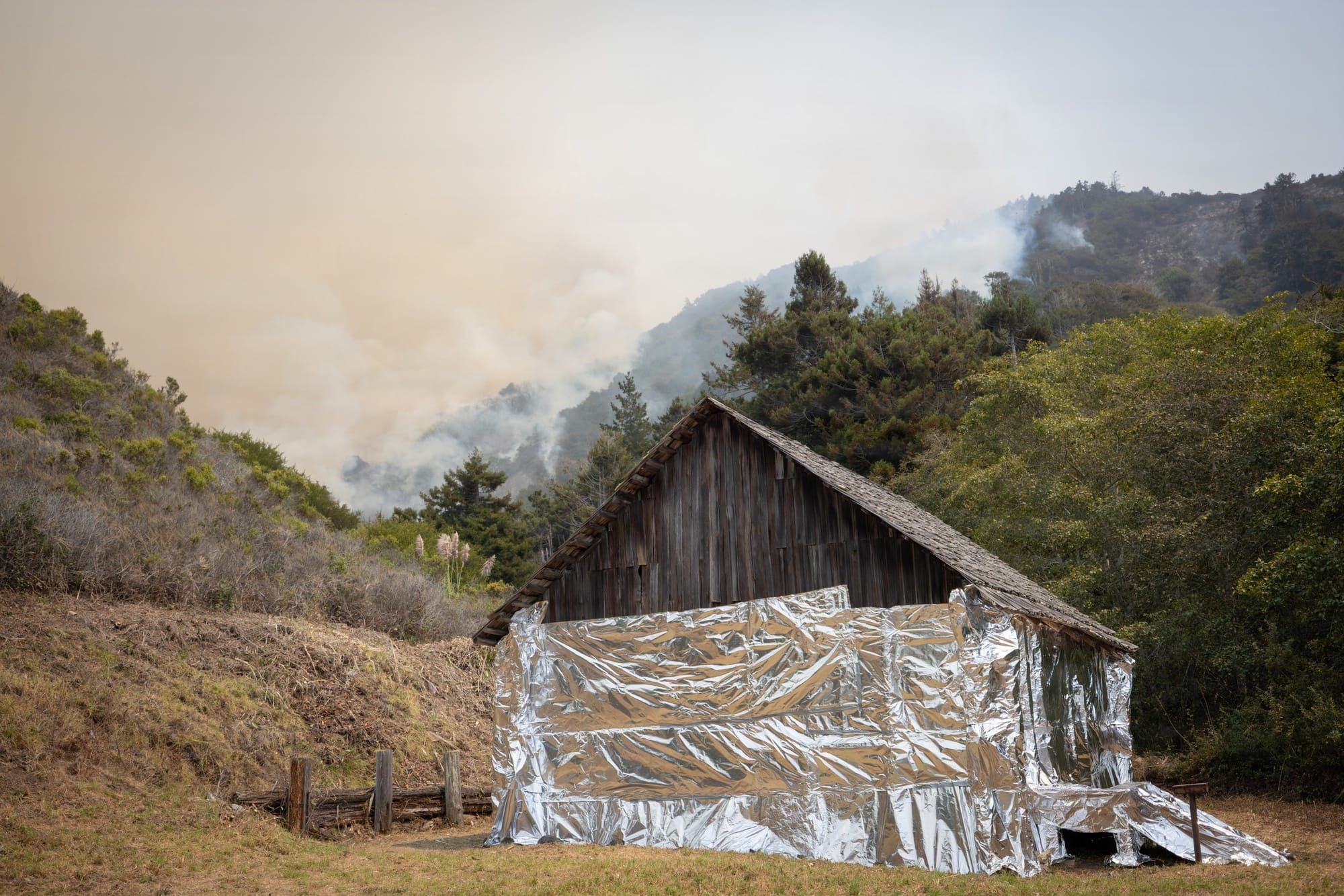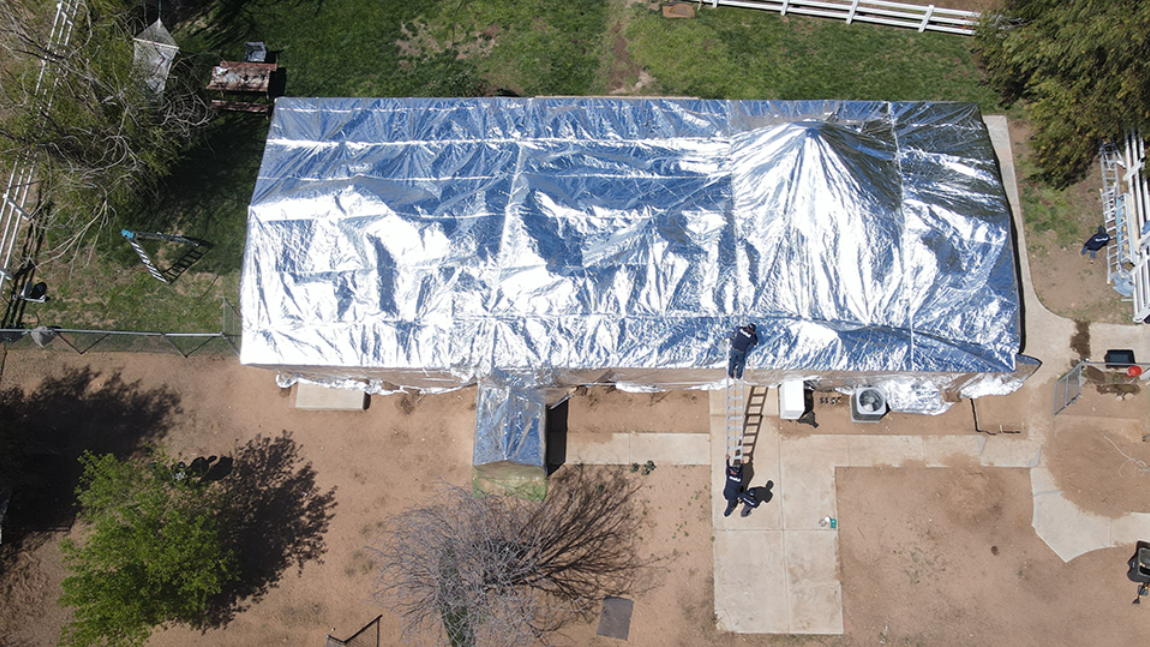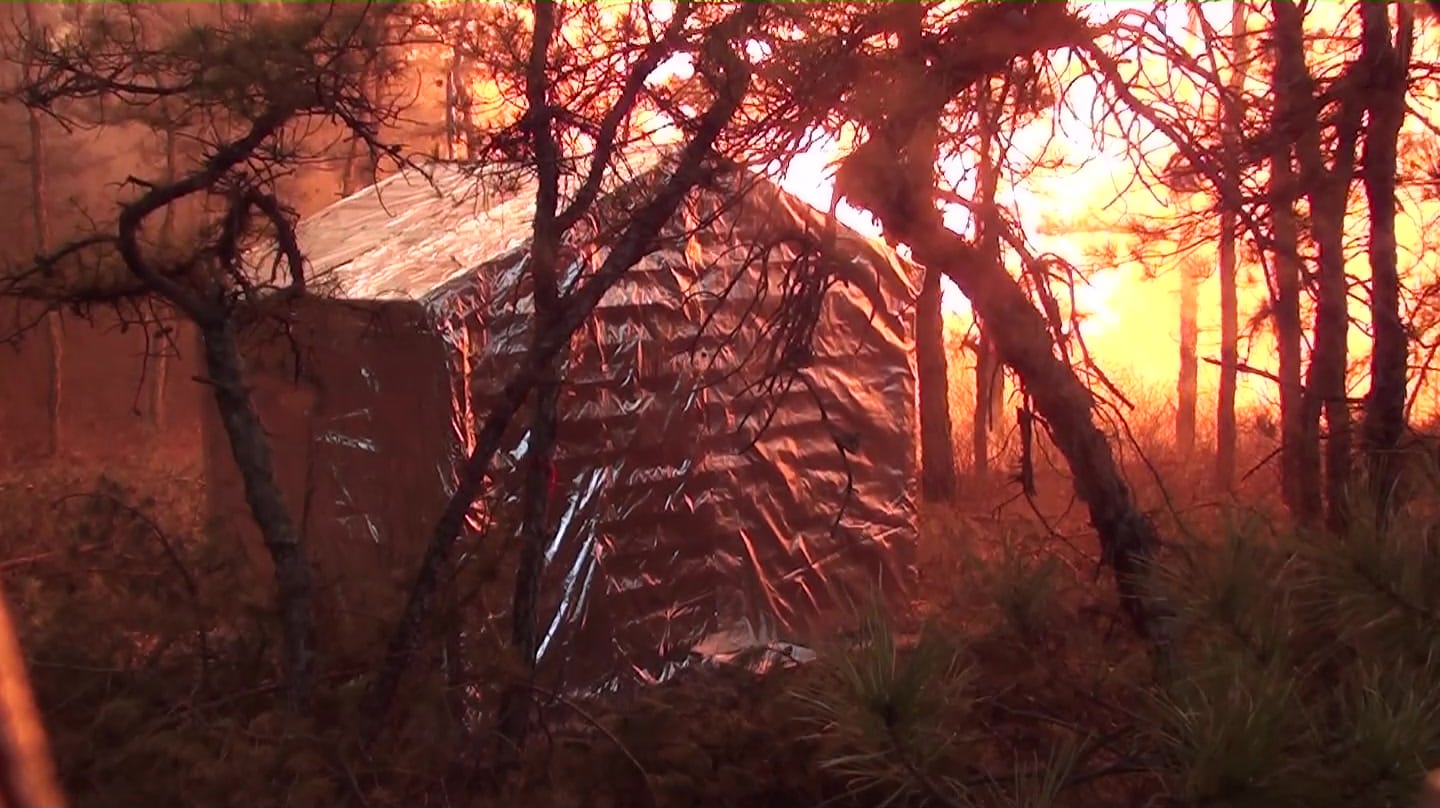
Structure wrap looks simple. A reflective sheet goes over a building, the fire passes, the building is still there. The mechanism is worth understanding properly, because knowing how it works also tells you where it stops working.
There are two jobs. Turning back radiant heat, and physically covering the places embers get in. They are different problems with different evidence behind them.
Job one: reflecting radiant heat
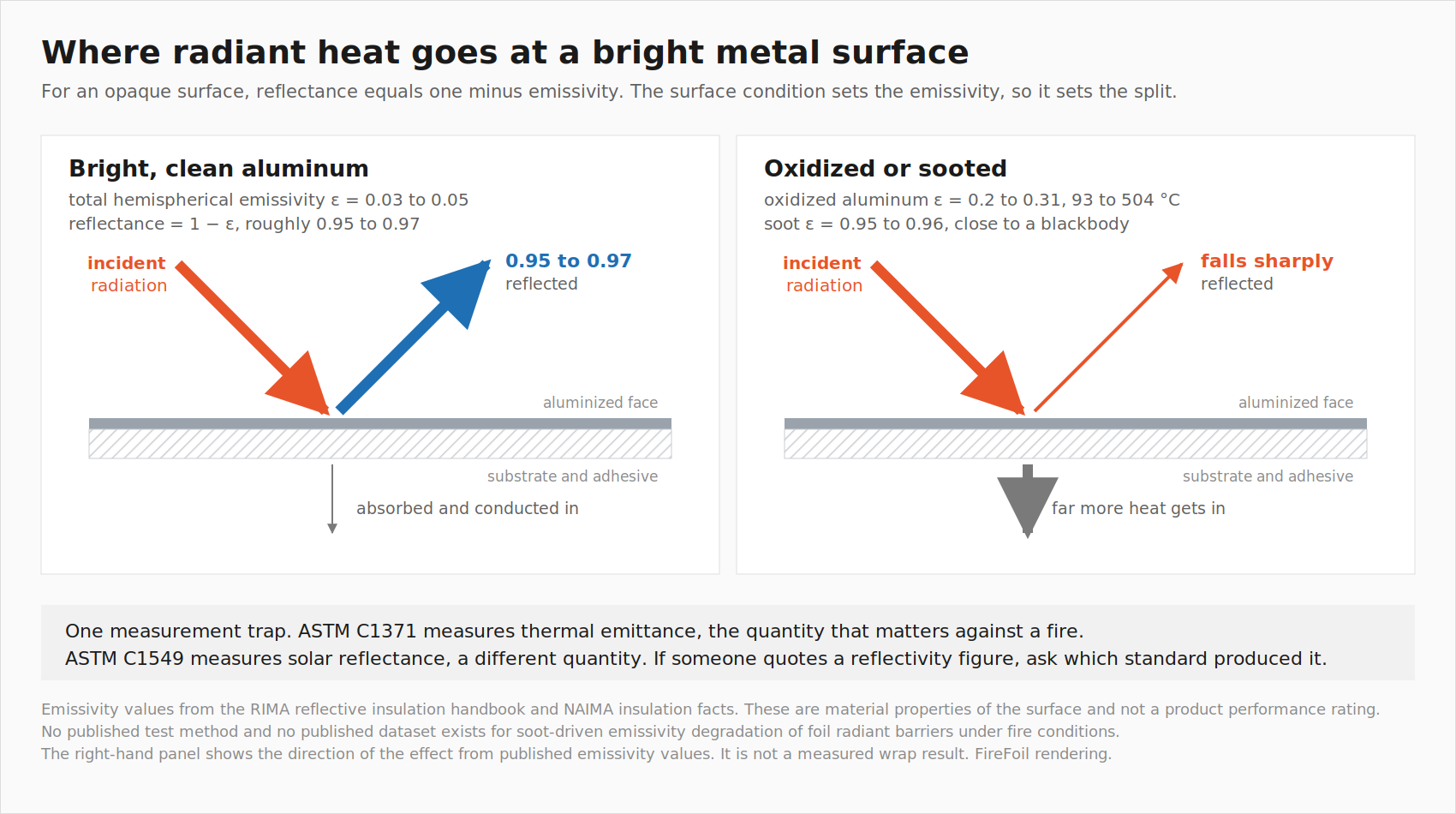
This part is just physics. Bright aluminum foil has a total hemispherical emissivity of 0.03 to 0.05. That figure comes from the Reflective Insulation Manufacturers Association handbook. For an opaque surface, reflectance is one minus emissivity. RIMA states the relationship directly: aluminum with an emissivity of 0.03 has a reflectance of 0.97.
So bright, clean aluminum reflects roughly 95 to 97 percent of thermal radiation. That is a material property of the metal. It is measured by ASTM C1371, the portable emissometer method that the US Department of Energy requires for radiant barrier labeling.
What degrades the reflective surface
Two things dull a reflective surface. Oxidation raises the emissivity of aluminum to somewhere between 0.2 and 0.31 across 93 to 504 degrees C. And soot behaves close to a blackbody, with emissivity of 0.95 to 0.96 across a wide temperature range. A sooted reflective surface is, optically, closer to a black one.
That gives you a rule about reuse. Heat and soot are precisely the two things that degrade the surface, so panels that have taken a fire front are spent and should be replaced rather than redeployed. Panels that were installed and never reached by the fire are a different case. They come down, get inspected for soot, tears and adhesive failure, and go back into storage for next season.
If your foil did take the fire, reach out. We will help you replace it at a discount. A season where the wrap did its job should not end with you paying full price to be ready for the next one.
Job two: covering where embers land
Radiant reflection is the part people picture. Coverage is the part that decides outcomes, because embers cause most of the losses.
Where do they accumulate? IBHS ran full-scale wind-blown ember tests at their research center, published by Quarles and colleagues in 2023. Collection pans sat at ground level in thirteen orientations at wind speeds from about 4.5 up to 17.4 meters per second, over 15 minute exposures.
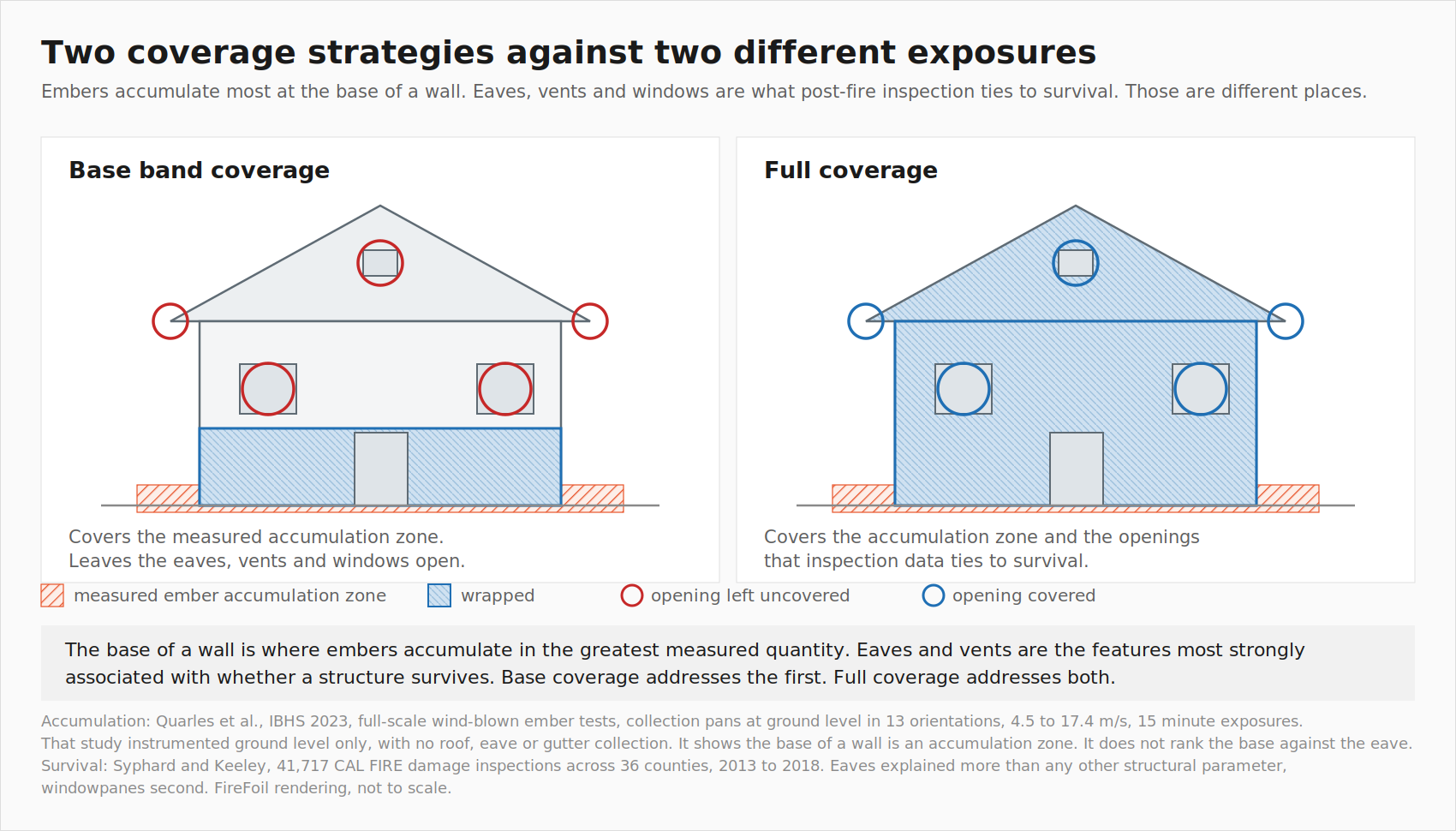
The pattern they report: accumulation peaks at the ground-to-wall intersection, and wall sections collected more than open field sections at a given wind speed.
Where structures actually fail
Accumulation tells you where embers land. It does not tell you what decides whether a building survives. For that you need post-fire inspection data.
Syphard and Keeley analyzed CAL FIRE damage inspection records covering 41,717 structures examined across 36 counties between 2013 and 2018. Their finding, in the paper's words, is that eaves consistently explained more than any other structural parameter. Windowpanes came second. The trio they name as most consistently important is enclosed eaves, vent screens, and multi-pane windows. All three are features that block ember entry.
Those two findings point at different parts of the building, and putting them together is what makes the coverage decision concrete.
- Embers accumulate in the greatest measured quantity at the base of a wall.
- Eaves and vents are the features most strongly associated with whether a structure survives.
- Base coverage addresses the first. Full coverage addresses both.
That is why we sell both, and why we describe the base system as the coverage a homeowner can realistically deploy alone in the time available rather than as a complete answer.
The five foot number, and the corner exception nobody mentions
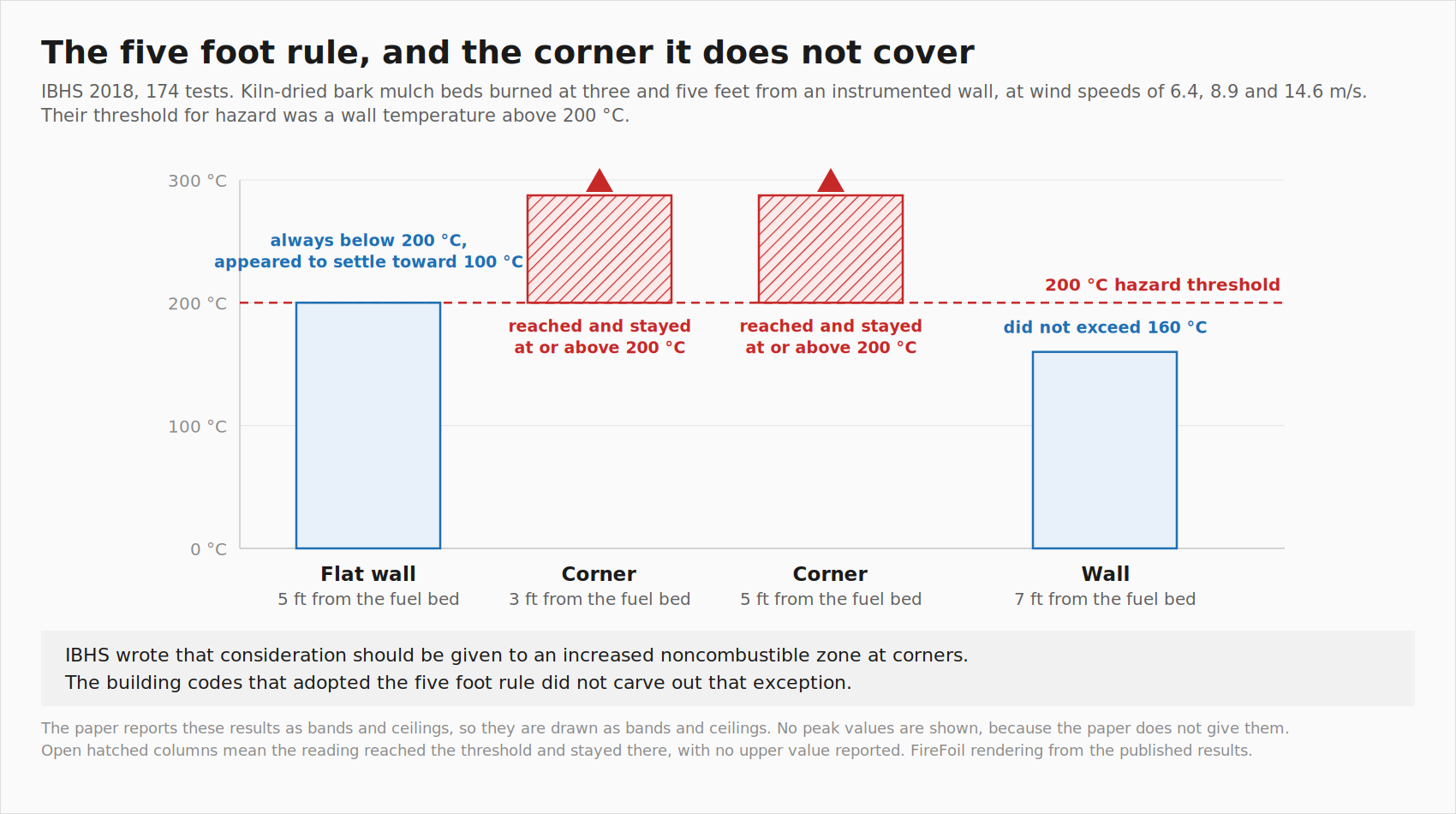
The five foot noncombustible zone now written into guidance came from an IBHS experiment in 2018. They ran 174 tests, burning kiln-dried bark mulch beds at three and five feet from an instrumented wall, at wind speeds of 6.4, 8.9, and 14.6 meters per second.
Their threshold for hazard was a wall temperature above 200 degrees C. At five feet along a flat wall, temperature was always below 200 degrees C and appeared to settle toward 100 degrees C.
At corners it behaved differently. At both three feet and five feet, corner wall temperatures reached and stayed at or above 200 degrees C. Only at seven feet did they stay below 160 degrees C. IBHS wrote that consideration should be given to an increased noncombustible zone at corners.
The building codes that adopted the five foot rule did not carve out the corner exception. If you are planning coverage on a real building, corners deserve more attention than a uniform band implies.
Where FireFoil comes in
It needs no water, no chemicals, and no electricity, and once it is on it does not need anyone standing next to it. Those are real advantages when an evacuation has removed the people.
It is also, in itself, not a panacea. We recommend you think of FireFoil as one crucial part of a layered defense plan, working alongside home hardening, defensible space, and a predetermined wildfire action plan for the day a fire actually moves toward you. Each of those three is a free tool from FireFoil’s parent company, AACI Group, and each will score your property in a few minutes.
NOTE: FireFoil is not a survival shelter. Nobody should be inside a wrapped structure, and nobody should wrap themselves, another person, or animals.
Where to go from here
Coverage is the dial in all of this. The base of a wall is where embers accumulate in the greatest measured quantity, the eaves and vents are what post-fire inspection ties to survival, and the corner exception means a uniform band is not the whole answer.
That decision gets easier with a number in front of you. FireShields, our distributor for property owners, will size a building either way. Enter the footprint and the number of stories, pick base perimeter coverage or a full wrap, and compare what each one costs and how much seam each one creates.
For the evidence behind the figures this category quotes, read Where the 96% Figure Comes From. For what happens at the seams, and why panel width matters, read 18 Hours of Smoldering.
Size your coverage at fireshields.com/buy
If you are not sure which of those two jobs matters more on your building, reach out. We will walk the exposure with you, work out where the coverage has to be continuous and where a band is enough, and build a personalized protection plan around it.
Commercial property, or interested in carrying FireFoil? Call (855) 918-3473, email info@firefoil.com, or get in touch here.