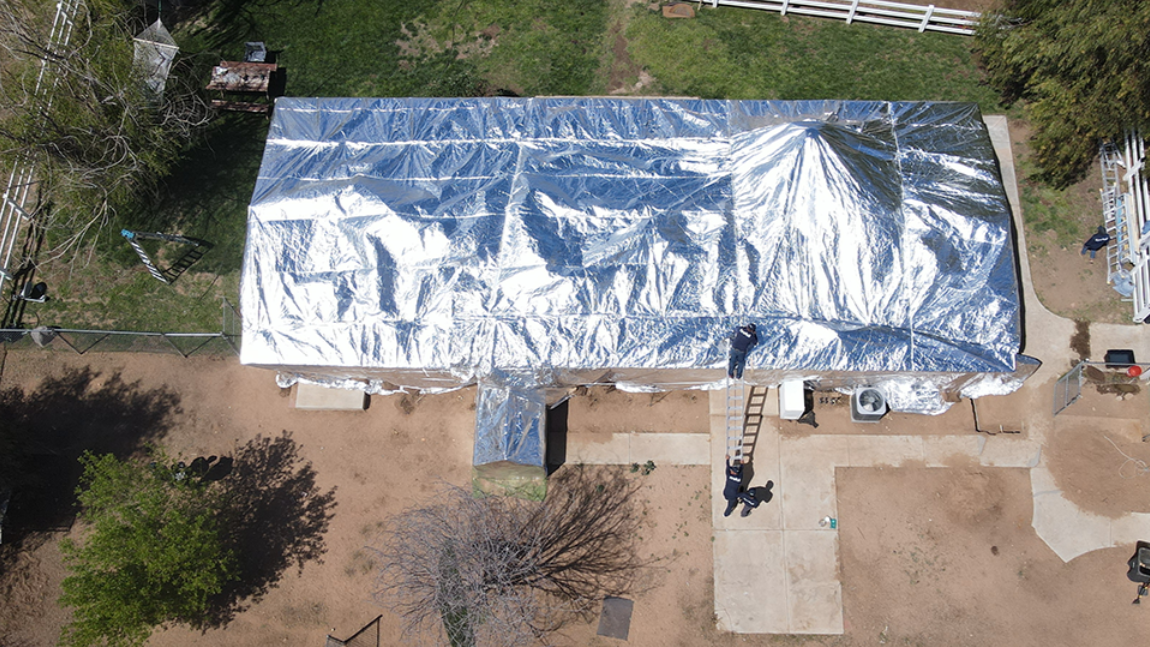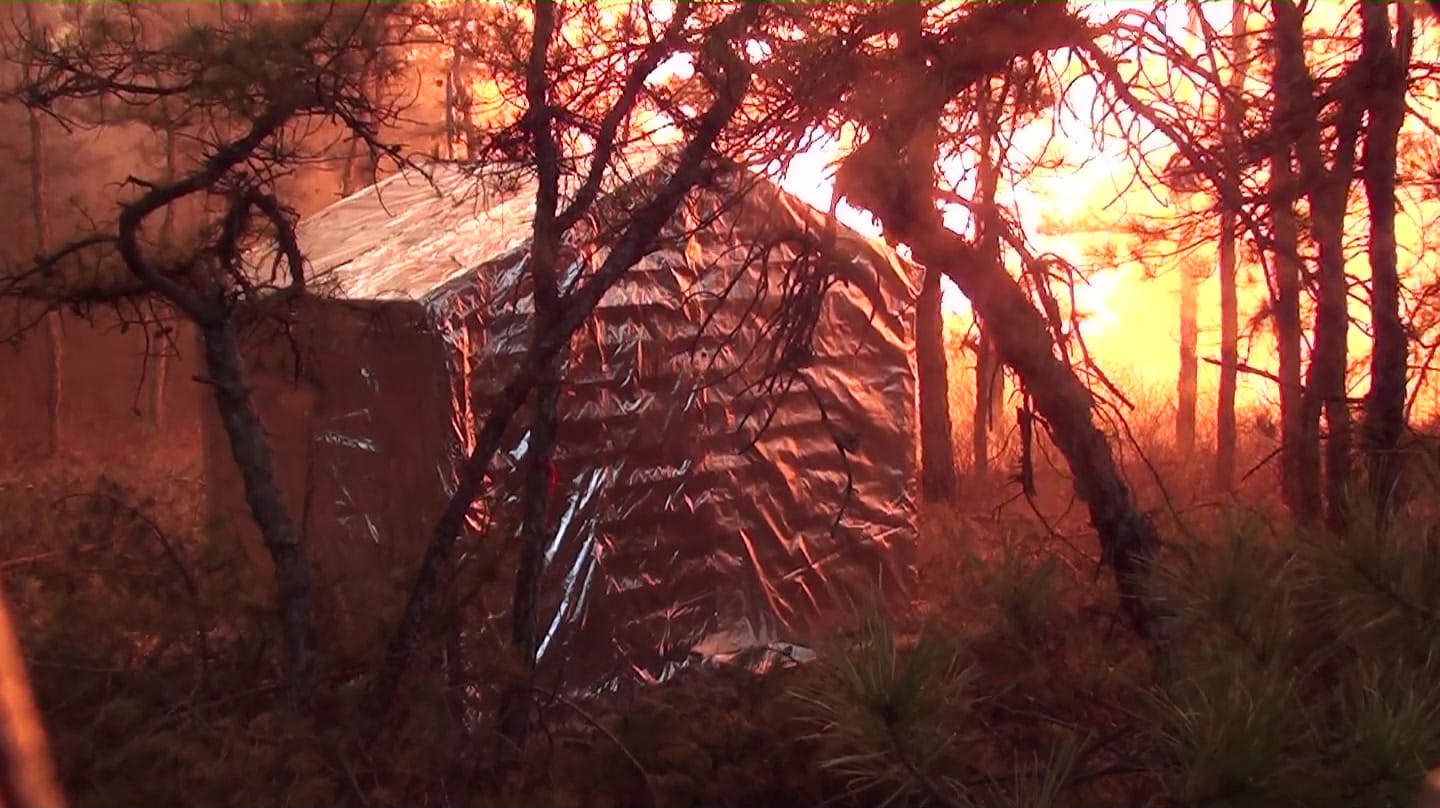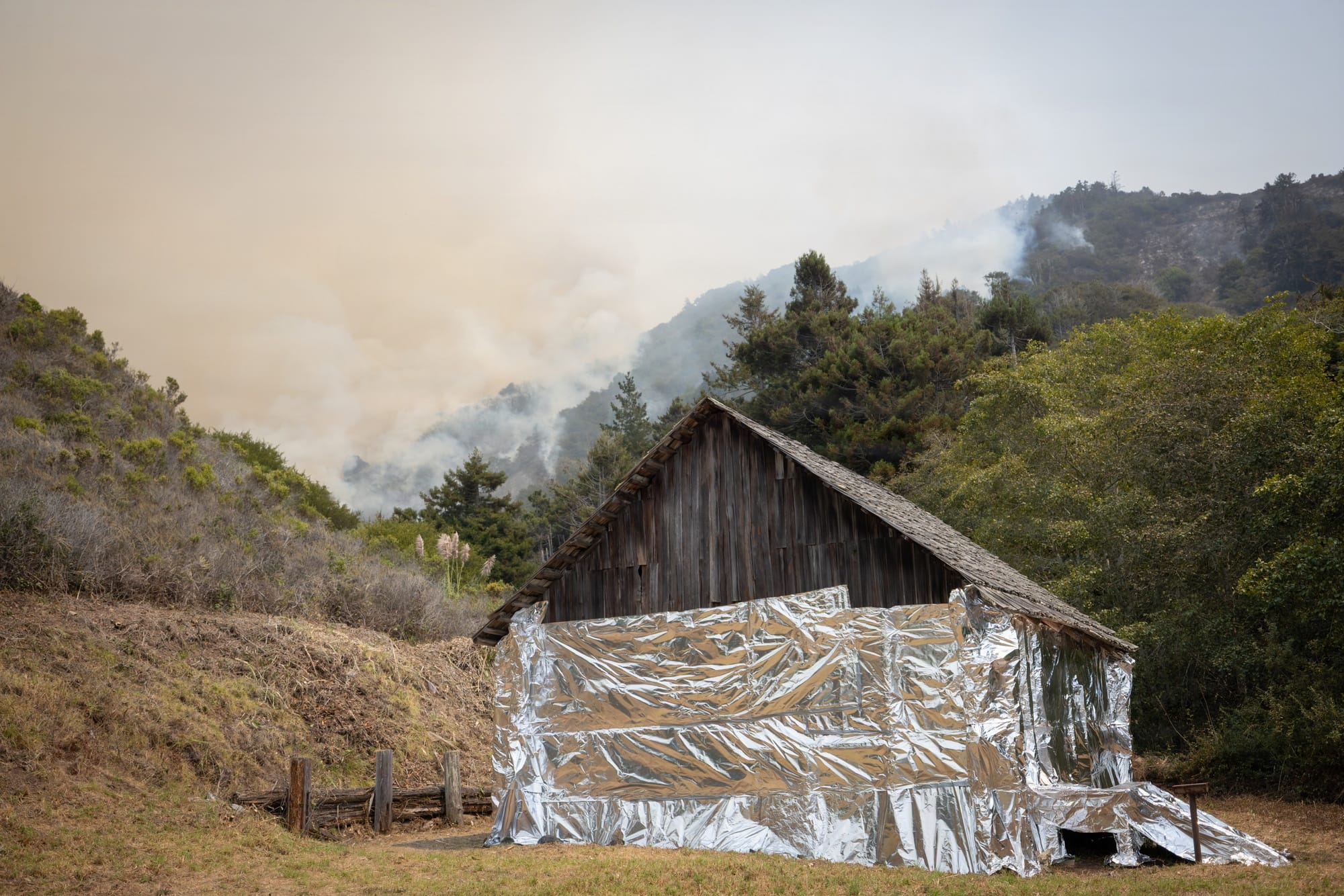
Wrap is a pre-event product, designed to wrap a structure when a fire is forecast or an evacuation warning is up, giving you time to evacuate safely. This timing allows you the option to defend reactively rather than proactively, and support the layered defense you've built over time. While home hardening may require a contractor and building permits, and defensible space may entail replanting and regular upkeep, FireFoil wrap goes on in hours, not weeks.
That's why the amount of wrap you're able to deploy in the time you have can be the difference between a total loss and a property saved.
Most of the time goes to edges
When the warning comes, the job is measured in hours, fasteners, and seams. Very little of that time goes to unrolling foil. It goes to edges: fastening each top edge, lapping and taping each seam, closing each roll end. Every extra row of wrap can mean another full trip around the house.
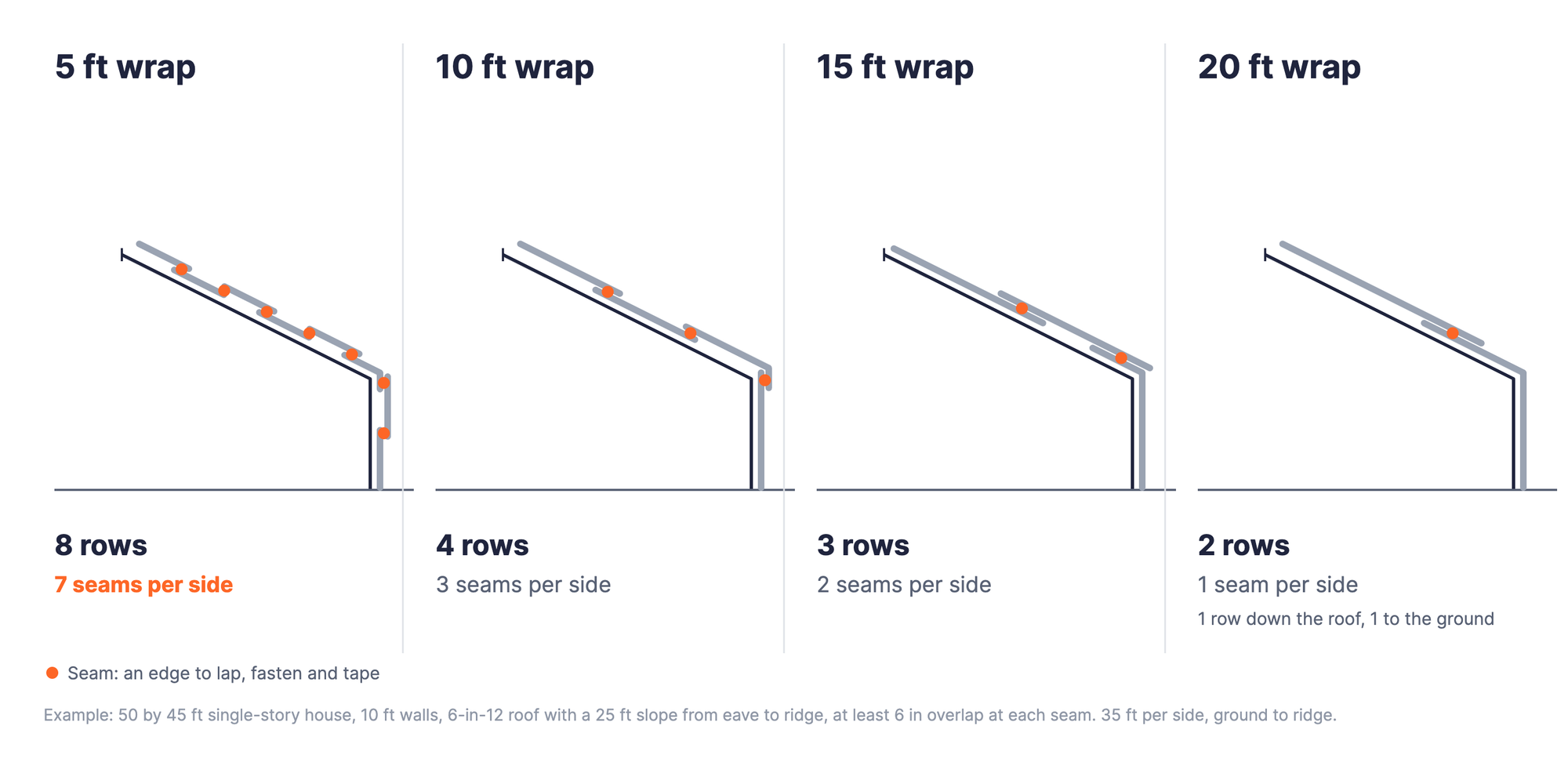
Take an ordinary single-story house: a 50 by 45 foot footprint, 10 foot walls, and a 6-in-12 roof whose slope runs 25 feet from the eave to the ridge. That is 35 feet per side from the ground to the ridge.
Lay that in horizontal rows with at least a 6 inch overlap at each seam and the count is simple. 5 foot wrap takes eight rows. 10 foot takes four. 15 foot takes three. 20 foot takes two: one row covers the roof from the ridge down, and a second runs from the ground over the eave and laps under it.
The rows on the walls are full laps around the house, and the rows above the eave run up both sides of the roof. Every row is another edge to fasten and another seam to lap and tape, so going from 5 foot to 20 foot wrap cuts the rows, the seams and the edges to fasten by about four times.
Roll length does the same work around the house. Every roll end is a vertical seam. On a 190 foot perimeter, 100 foot rolls leave two of them, and 50 foot rolls leave four.
Fewer seams, fewer fasteners, less tape, less time on a ladder. When the deadline is an evacuation order, that is time you get back for the rest of the structure, or for leaving.
Fewer edges also means fewer ways to fail
Edges are not only where the time goes. They are where a wrap comes apart. Wind does not attack the middle of a panel. It finds an edge, gets underneath, and peels.
That is not a theory. In 2014 the U.S. Forest Service San Dimas Technology and Development Center published an evaluation of eighteen structure protection materials, including seven wraps, tested both in the lab and on full-scale outdoor walls and roof decks. The finding, in the report’s own words: although none of the wraps ignited in the lab tests after 30 minutes, “all of them ignited within 3 minutes during the outdoor tests.” The report traces it to the material delaminating from “the peeling effect” of wind and direct flame contact, in winds of just 1 to 6 miles per hour.
Two of the seven wraps were our own earlier construction, and it’s why our current line is built around fewer seams.
What we ship
FireFoil L70 comes in 5, 10, 15 and 20 foot widths. The 5 foot rolls come in 200 and 300 foot lengths, and the 10, 15 and 20 foot rolls in 50 and 100 foot lengths. The sizing rule is simple: pick the width from your gutter-to-ground measurement, then pick the length from your perimeter. If you have more questions on sizing, please refer to our coverage calculator.
Holding down the edges that remain
Width cuts the number of edges. These are the ways crews hold the ones that are left. There is no single right fastener: each does a specific job, and most deployments use three or four together.
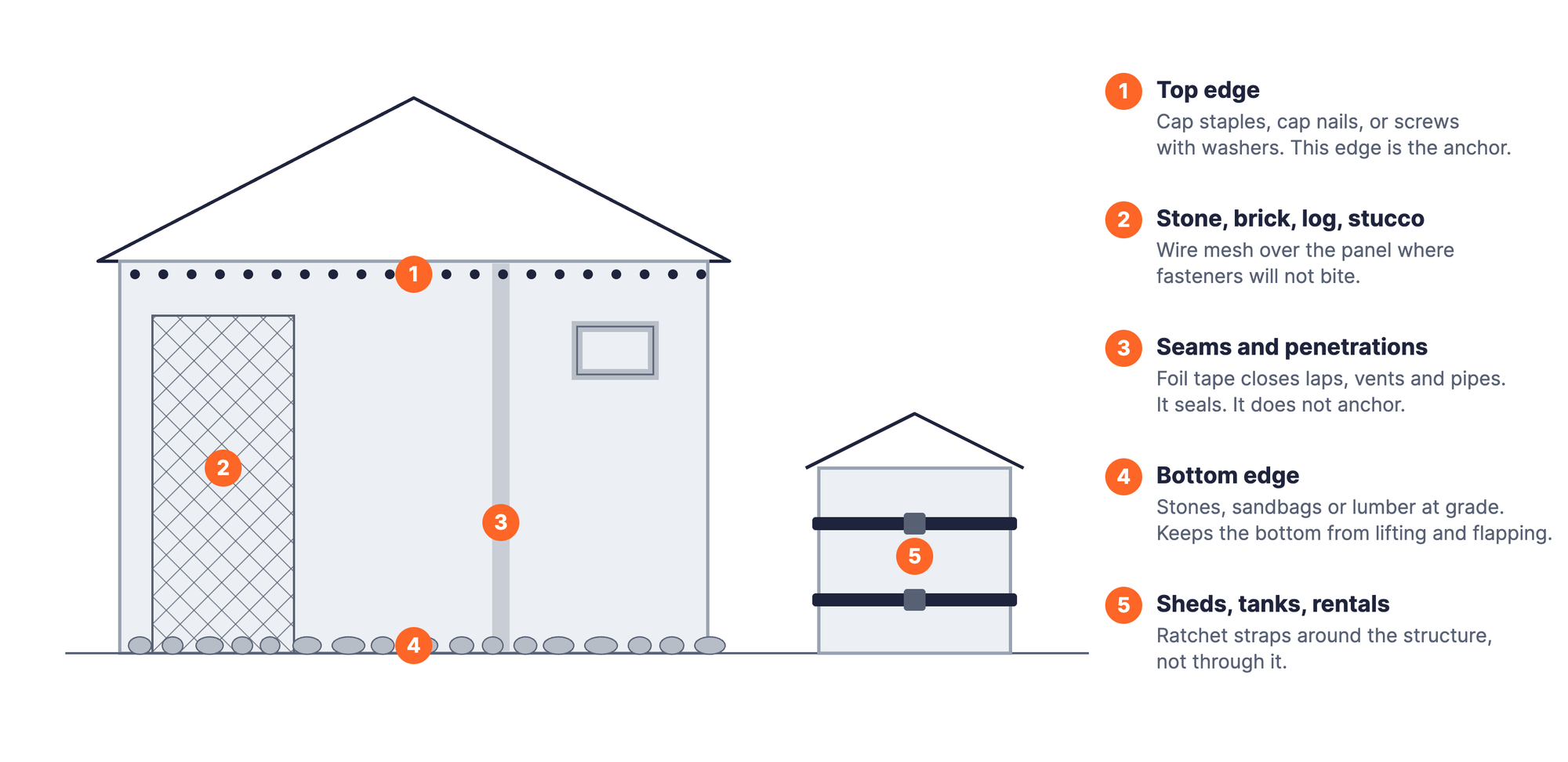
Cap staples and cap nails. The workhorse for wood trim, fascia and exposed sheathing. The cap is the point. A plastic or metal washer spreads the pull across a wide area of the fabric. A bare staple concentrates the same load on two thin legs, which is how a top edge unzips in wind.
Screws with fender washers. Slower to place and the strongest option per fastener. Worth the time on the top edge, which is the edge that carries the load, and on any corner that will see direct wind.
Ratchet straps and banding. Wrapped around the structure rather than through it. This is the answer for sheds, pump houses, propane enclosures, water tanks and anything you would rather not put holes in. It also works on a rental.
Wire mesh over the panel. Poultry netting or hardware cloth run over the top of the wrap and anchored at the perimeter. Use it where fasteners will not bite: log walls, stone, brick, stucco over foam. The mesh captures the panel mechanically instead of relying on the fabric to hold a fastener.
Ballast at grade. Stones, gravel, sandbags or scrap lumber laid along the bottom edge. This keeps the bottom from lifting and flapping, which is what tears a panel from below. Treat it as what it is: edge control. The top edge is the anchor.
Foil tape at seams and penetrations. Closes laps and seals around vents, pipes and meter boxes to close the gaps embers use. Tape is a seal, not a structural fastener, and adhesives soften under sustained heat. Do not ask a taped lap to do a fastener's job.
Start early and work in calm conditions. If sustained wind passes about 15 miles per hour or gusts pass 20, stop. Keep the work at ground level where you can, and leave when you’re told to leave, finished or not.
Where to go from here
The time to measure is before the warning, not during it. Perimeter and gutter-to-ground tell you exactly what to order, and here is where to get it.
Source: Structure Protection Materials Evaluation, U.S. Forest Service, San Dimas Technology and Development Center, report 1251 1811-SDTDC, October 2014.