That Is a Fair Question
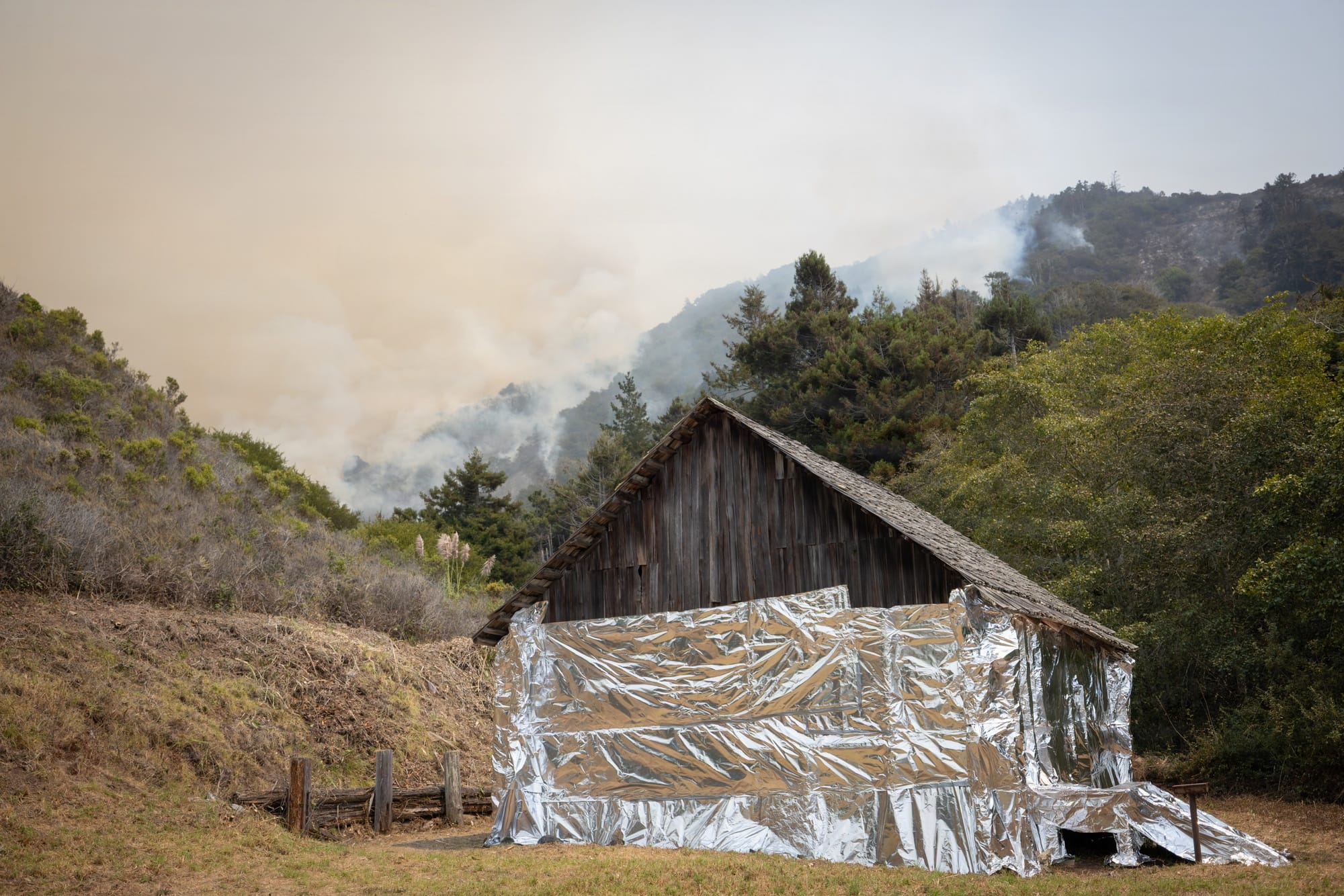
The U.S. Forest Service has used aluminum structure wrap for more than 30 years to protect historic cabins, fire lookouts, ranger stations, bridges, cultural resources, and other high-value assets. Over the last 20 years, Firezat and the Forest Service have provided more than 30 million square feet of structure-protection wrap. An internal Forest Service performance review covering 1,873 wrapped structures from 2017 through 2023 documented only 29 structures lost or partially damaged, a 98.4% survival rate.
If performance is that strong, why hasn’t structure wrap been used more widely? The short answer is that effectiveness and scalability were two different issues until recently.
The material evolved over 12 years from 36-inch widths to 42, 48, 54, and eventually 60 inches as laminator capacity expanded. The familiar 5-foot roll worked for remote cabins and irreplaceable historic structures because agencies could justify trained crews, ladders, roof access, thousands of staples, and hours of labor, since it was highly effective and required no further human intervention once installed. It did not translate efficiently to thousands of full-size homes. In 2025, we created a system to securely construct Fire Shields that are now 240 inches wide, or 20 feet: a game changer.
The Paradigm Shift in Structure Protection: Tactical Use of Larger Fire Shields
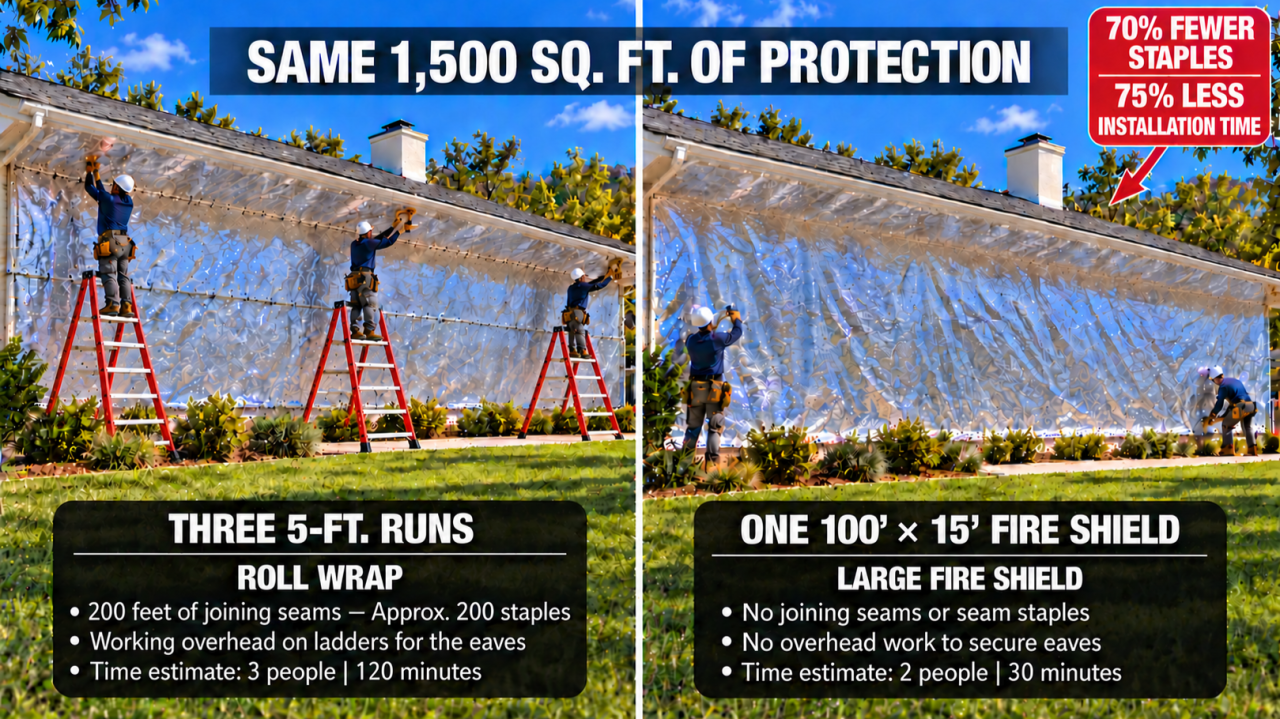
The installation image comparison accompanying this article shows two methods covering the same 1,500 square feet:
- Roll wrap: Three 5-foot runs measuring 100 feet each. This method creates about 200 feet of joining seams, requires approximately 200 seam staples, involves overhead ladder work at the eaves, and is estimated to require three people working for 120 minutes.
- Large Fire Shield: One 100-foot by 15-foot shield with no joining seams or seam staples, no separate overhead work to secure the eaves, and an estimated two people working for 30 minutes, including anchoring.
For a typical 2,000-square-foot single-story home requiring approximately 5,000 square feet of exterior coverage for roof and walls, preliminary estimates indicate:
- Roll wrap: approximately 8 hours with 3 people = 24 labor-hours
- Large shields: approximately 2 hours with 2 people = 4 labor-hours
The larger shield reduces estimated elapsed installation time by 75%, total labor by 83%, and staple use by 70%. These estimates will be tested in an upcoming deployment time study this winter.
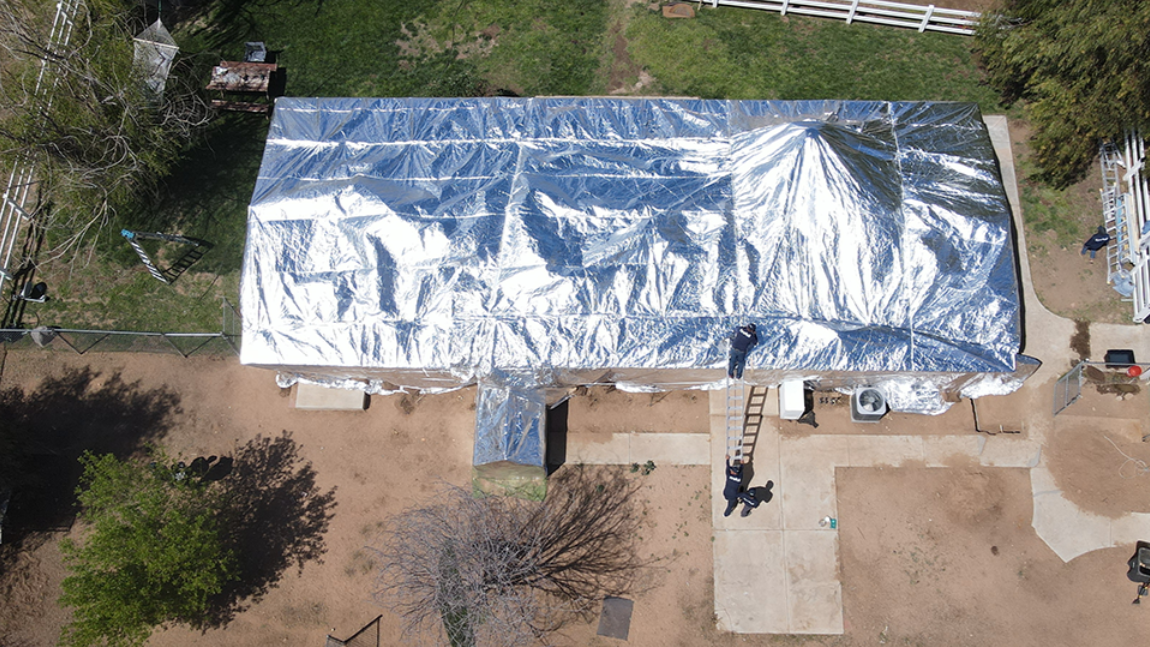
A large shield is not simply more material in one package. It eliminates work. One piece runs from the roof edge, under the eave, down the wall, and to the foundation. That means fewer ladder moves, fewer seams, no overhead work on ladders, and fewer places where wind or embers can challenge the installation.
Why This Matters to Insurance Carriers and Fire Agencies
A $5,500 structure-wrap kit, reusable for more than 10 years, gives carriers a practical way to help prevent a modeled $900,000 total loss. Saving one home, or reducing it to smoke-only damage, could fund an entire pilot while leaving protection on-site for 100 homes for 10 years of future fires.
Structure wrap is a tactical mitigation strategy for homes that remain partially hardened or have limited defensible space. When a wildfire approaches and evacuation time is short, faster DIY installation reduces labor and ladder time, protects more properties with available resources, and preserves the evacuation window when the wrap is already on site. Because fire and embers may arrive hours, days, or weeks later, deployment efficiency and durable protection matter. Fewer seams also simplify installation, inspection, and verification.
A carrier or agency program still requires selecting properties in extreme- and high-risk ZIP codes, staged inventory, delivery planning, installation standards, and verification. Larger shields simplify each step because fewer pieces must be transported, installed, inspected, and stored.
NIST states that emergency directional hardening against an approaching wildfire can improve outcomes by protecting the expected first-contact exposure surfaces. When full coverage is not possible, a 100-by-20-foot shield provides 2,000 square feet of rapid tactical protection on the highest-exposure side, including the side facing an unhardened neighboring home, and can be deployed in less than 30 minutes during an emergency.
FireFoil will conduct an IBHS-style burn test using structures representative of homes built in the 1980s. The test will evaluate the tactical application and effectiveness of structure wrap, including its ability to interrupt structure-to-structure ignition. Heat-flux and temperature data will be captured under conditions representing homes where wildfire hardening has not begun or remains incomplete.
We will also conduct a deployment study to compare large fire shields with conventional rolls, measuring installation time, crew requirements, staple use, seams, handling, and completed-wrap quality. A Q1 follow-up article will report the findings and explain how insurance carriers can apply them to pilot programs.
The Benefit May Extend beyond the Wrapped Home
Once a home ignites, it can become a large fuel source that exposes neighboring structures to flames, radiant heat, and excessive firebrands. A properly installed wrap may help interrupt that cascade by reducing ember entry, radiant-heat exposure, and limited direct flame impingement.
That community-scale benefit warrants further study, but it matters to carriers and fire agencies. Preventing one structure ignition may reduce the threat to surrounding homes and firefighters, while also limiting the potential for a single loss to develop into a neighborhood conflagration.
Structure wrap has proven it can save structures. Larger Fire Shields now make DIY installation practical, providing meaningful protection for homeowners and significant loss-reduction potential for insurers.
Sources
- U.S. Forest Service internal structure-wrap performance review, 2017-2023; presented at the 2024 Wildland-Urban Interface Conference.
- National Institute of Standards and Technology, Technical Note 2205, WUI Structure/Parcel/Community Fire Hazard Mitigation Methodology, 2022.