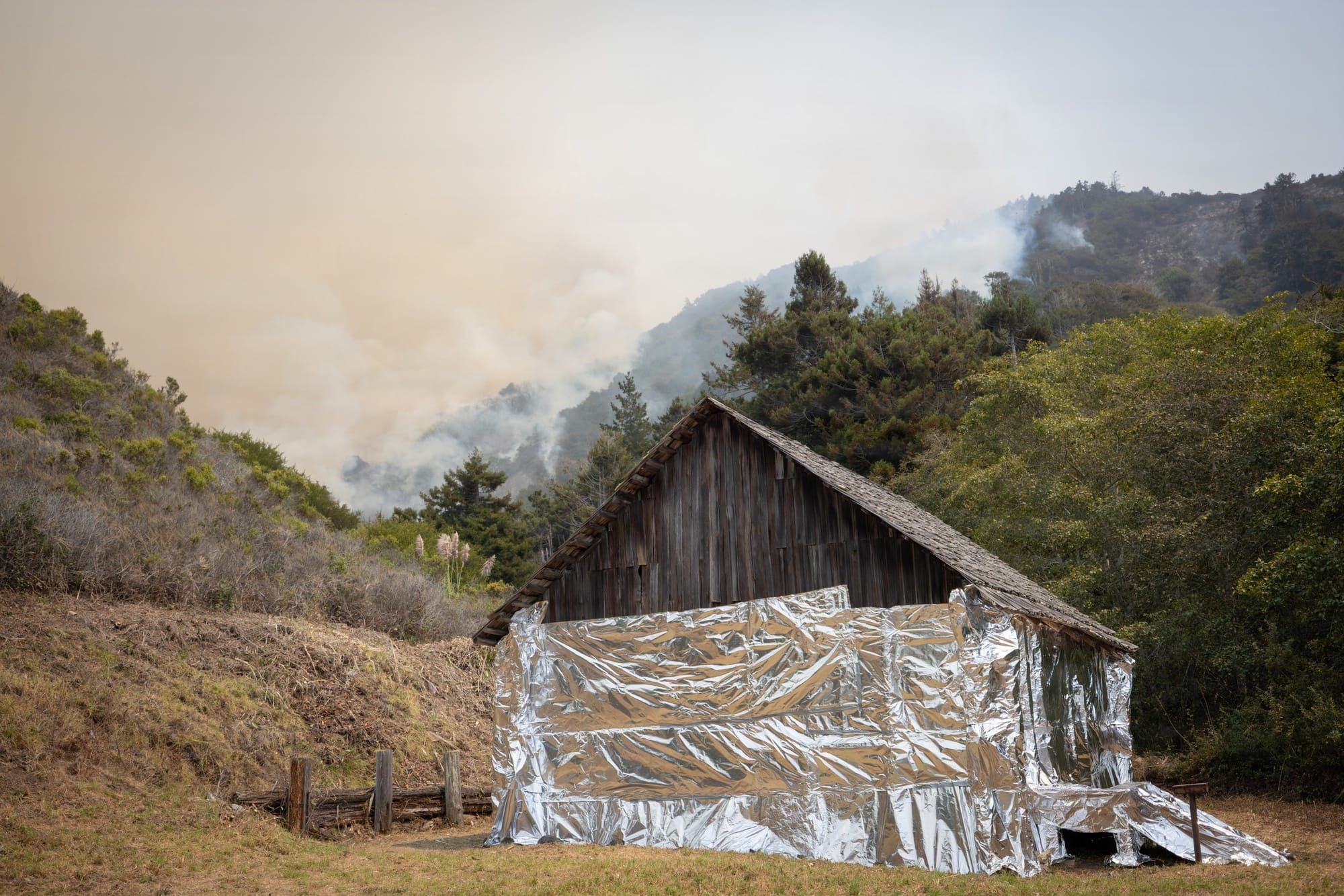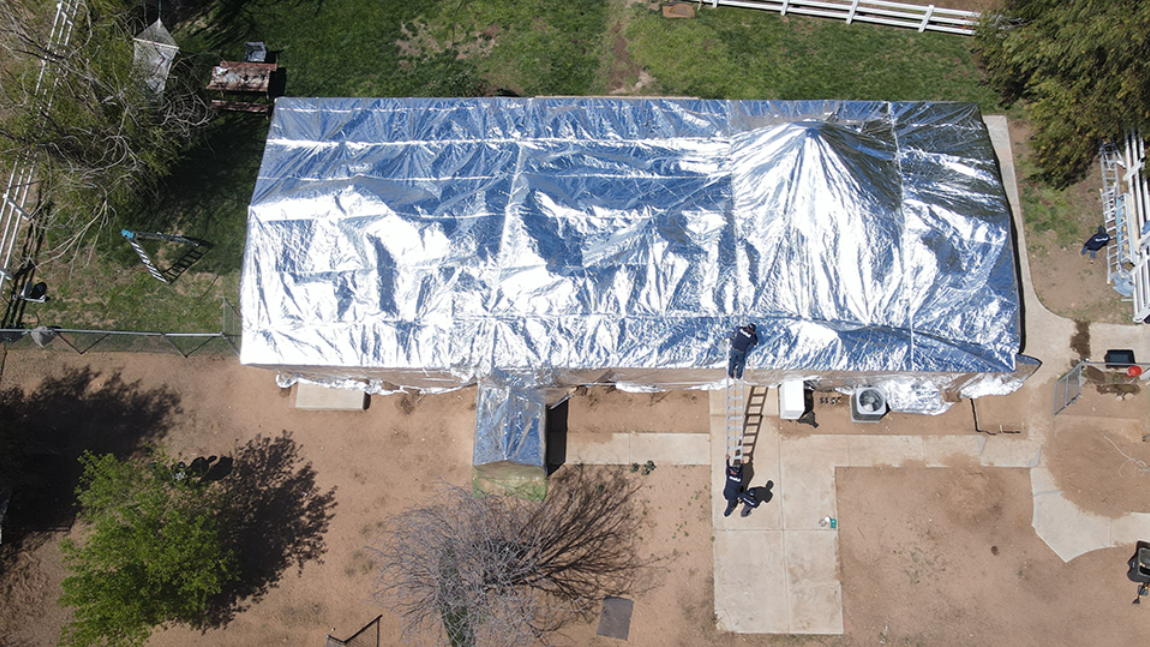
Search for aluminized structure wrap and you will find the same number everywhere: "up to 96 percent." It appears on manufacturer sites, in trade write-ups, and in our own marketing. Let's learn more about what it means and where it comes from.
The study
The figure comes from Fumiaki Takahashi, published in 2019 in Frontiers in Mechanical Engineering (volume 5, article 60). It is open access if you want to read for yourself.
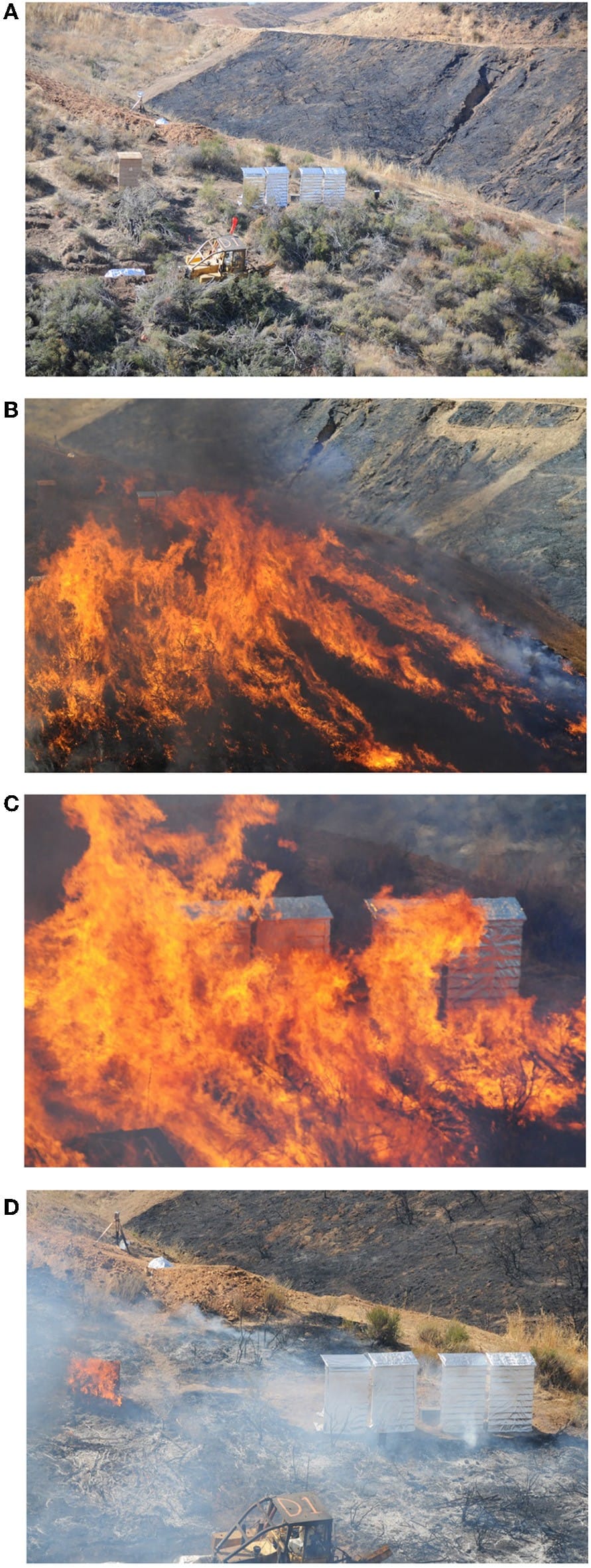
The work ran at four different scales, which is unusual and is the reason it carries weight. There were laboratory convective tests using a Meker burner, radiant tests using a cone heater at 84 kW/m2, burn-room tests on small structures, and wall and eave panels exposed to a prescribed burn in California chaparral. Lastly, there was a full cedar shed placed in the path of a head fire in the New Jersey Pine Barrens.
The materials tested included structure wrap products alongside fiberglass, silica, and composite fabrics.
What it found
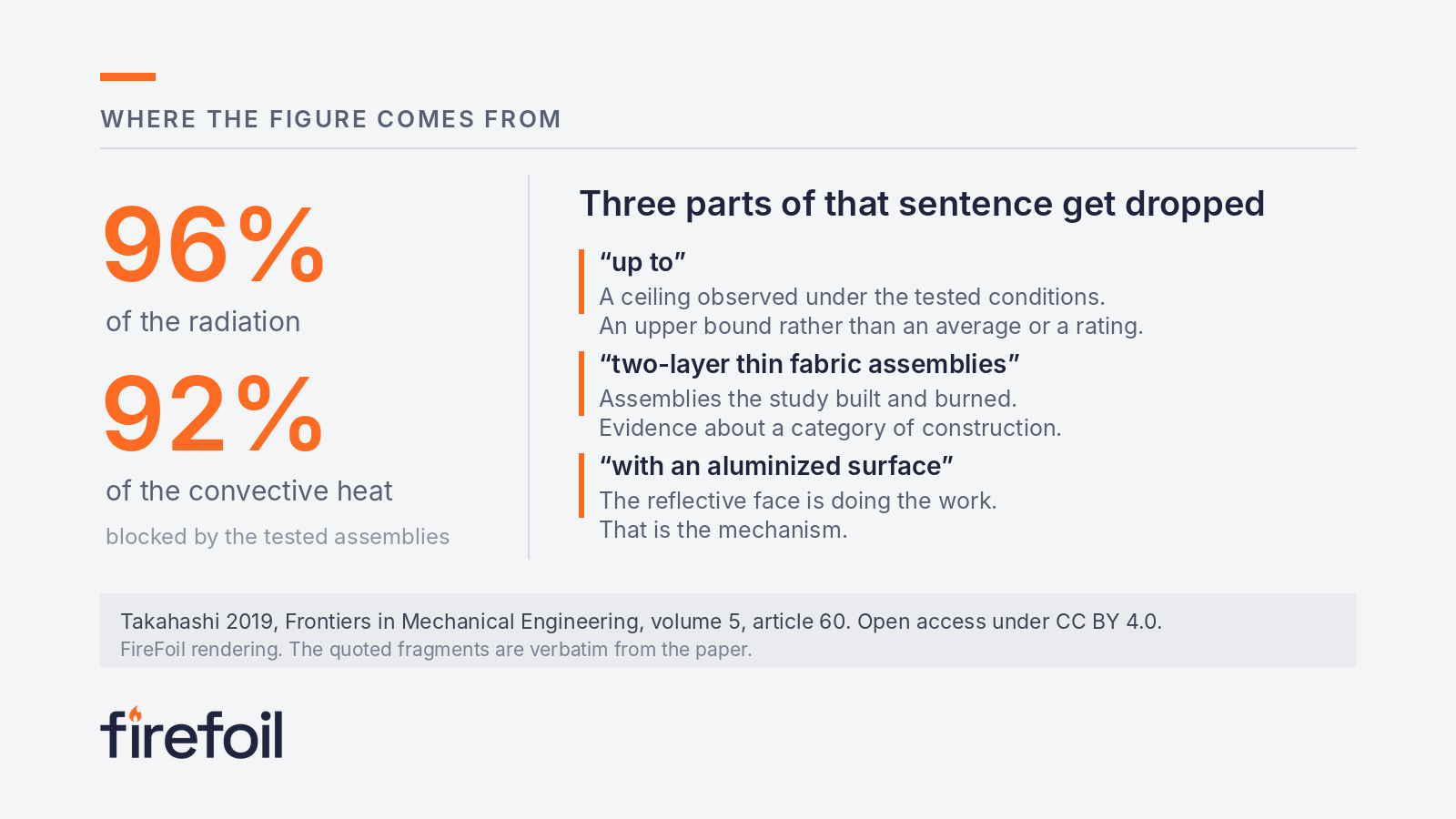
The sentence the number comes from reads, in the paper's own words: two-layer thin fabric assemblies were able to block up to 92 percent of the convective heat and up to 96 percent of the radiation, with an aluminized surface.
Three things in that sentence get dropped when the figure travels.
"Up to." It is a ceiling observed under the tested conditions, and it is not an average or a rating.
"Two-layer thin fabric assemblies." The finding describes specific assemblies the study built and burned.
"With an aluminized surface." The reflective face is doing the work. That is the mechanism, and it is worth understanding for its own sake.
The 96 percent figure is category evidence and reflects the properties of the aluminum sheeting itself.
Why brief exposure changes the calculation
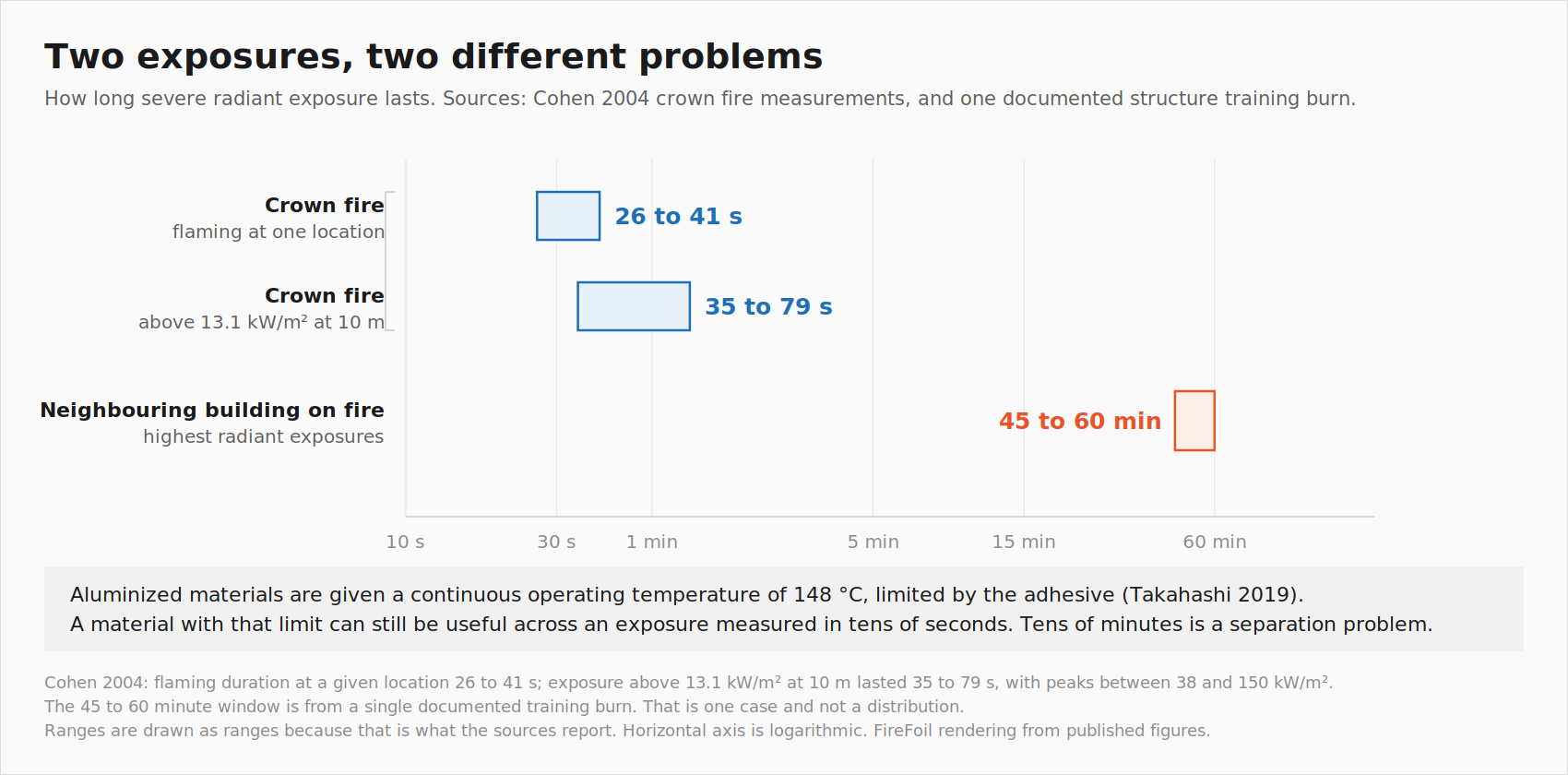
A fire front does not linger. Cohen’s 2004 crown fire measurements put flaming duration at a given location at 26 to 41 seconds. Exposure above 13.1 kW/m2 at 10 meters lasted 35 to 79 seconds, with peaks between 38 and 150 kW/m2.
Under a minute of severe flux, then it moves on. A material with a 148 degree C continuous limit can still be useful across an exposure measured in tens of seconds, because it is not being asked to hold continuously.
The comparison that should worry a homeowner more is a neighboring building on fire. A single documented training burn produced its highest radiant exposures across a 45 to 60 minute window. Tens of minutes is a different problem from tens of seconds, and separation distance is what governs it. IBHS field work after Lahaina in 2024 found that windward separation greater than 50 feet typically meant minimal or no visible damage, that below roughly 30 feet major damage and destruction increased significantly, and that below 10 feet most downwind homes were destroyed.
Where the real temperature limit comes from
Takahashi also puts a ceiling on aluminized materials that we have never seen a competitor quote. The continuous operating temperature of aluminized materials is given as 148 degrees C, and the paper is explicit that this is because it is based on adhesive temperature resistance. This proves that the overall wrap is only as strong as its weakest component(s); those being the stitching (if applicable), and the adhesive holding together the laminated layers.
In 2014 the US Forest Service ran its own structure protection materials evaluation, published as SDTDC 1251 1811 (Broyles). Eighteen materials, including seven wraps, tested in a cone calorimeter and an ICAL rig and then outdoors on plywood walls and cedar roof decks.
The result, verbatim: although none of the wraps ignited in the Cone and ICAL tests after 30 minutes, all of them ignited within 3 minutes during the outdoor tests.
The mechanism, also verbatim: the wraps ignited as the material delaminated from the peeling effect from close-surface aerodynamic forces caused by the combined effect of wind and strong direct-flame contact.
But the lesson survives both qualifiers, and it is the most useful sentence in the whole literature for anyone actually deploying this material: attachment and edges set real-world performance, and the laminate does not. A perfectly reflective sheet that peels at the seam in a light breeze protects nothing.
Why FireFoil is different
The wraps tested in all of this literature were the older heat-seal construction, and were not ember tests; the heat source was burning pallet cribs with standard test brands as pilots.
FireFoil is built that way, just built better. The 148 degrees C ceiling in that paper is an adhesive limit, and the delamination the Forest Service recorded is an adhesive failure. So the adhesive is the part we went after. Ours is proprietary, developed specifically to raise that temperature threshold, and it is the reason the newer construction does not behave like the material in those tests.
This is one area where FireFoil stands out from the crowd. We work continuously with our suppliers to improve the fire resistance of these parts of the material that pose a threat of failure. We have improved the adhesive, smoothed out the connective fiberglass layer to avoid abrasions, and chosen more fire-resistant binding materials that connect our wide-format shields together.
Where to go from here
Wide format is where that work shows up on a real building. Fewer panels across a wall means fewer joins to align, seal and anchor, and joins are exactly where the literature says wraps fail. That is why FireFoil is made in 5, 10, 15 and 20 foot widths rather than one size.
If you want to know what that means for your building, FireShields sells FireFoil direct and will size it for you. Enter the footprint, the number of stories, and whether you want base perimeter coverage or a full wrap. It returns the recommended kit, the total seam length, and the price.
One practical note that has nothing to do with performance. You cannot buy this during an evacuation, and neither can anybody else. In-stock sizes ship in one to two business days, and widths over five feet are fabricated to order. The decision has to happen while nothing is happening.
Size your coverage at fireshields.com/buy
Want the ember side of this? Read Most Homes Lost to Wildfire Never Touch a Flame. Working on a commercial property, or interested in carrying FireFoil? Contact us.