I will start with a field incident shared with me by a U.S. Forest Service (USFS) fire commander.
In approximately 2009, I received a call from a fire commander whose team was removing structure wrap from buildings that had been protected during a wildfire. He described an incident he wanted me to share with other fire wrap teams.
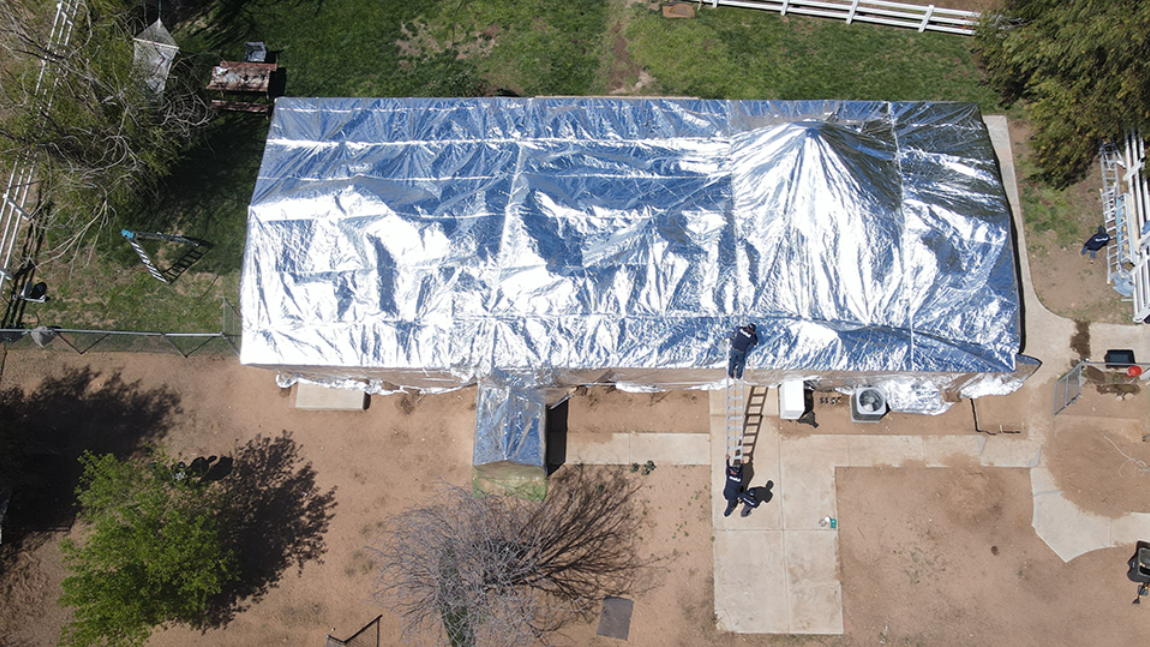
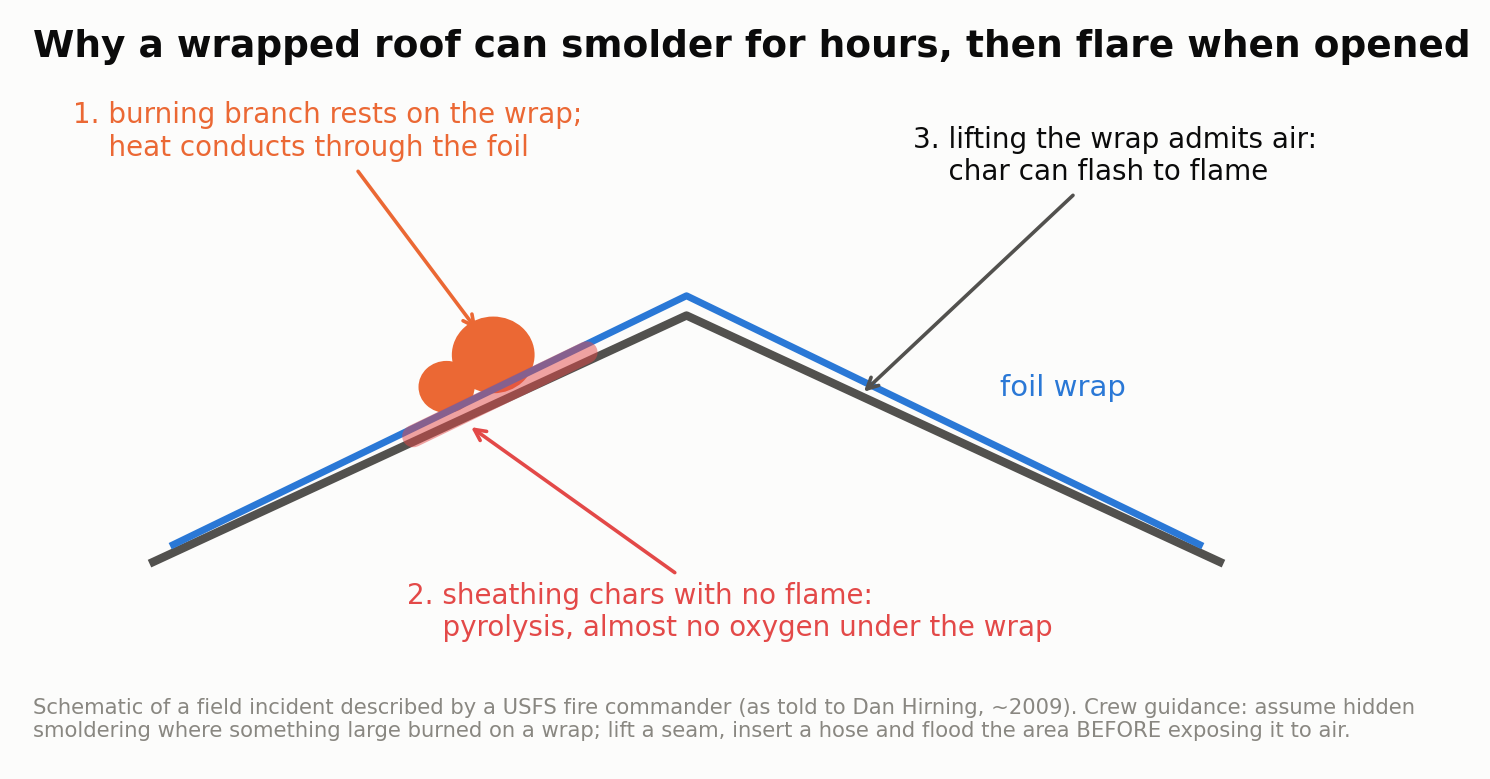
During the fire, the wind had broken a large branch from a tree and dropped it onto the roof of a wrapped house. From the ash pattern left on the foil, the crew estimated the branch had been about 12 feet long and roughly 7 inches in diameter at the larger end. It stayed where it landed and burned until its fuel was fully consumed, leaving an ash imprint on the foil.
At some point, enough heat conducted through the foil to make the roof material beneath it smolder and char. According to the commander, there was not enough oxygen under the wrap to support open flame. That process has a name, pyrolysis, and I will come back to it. He estimated the branch had burned out and the roof had sat in that oxygen-starved state for 12 to 18 hours before the crew returned. From the outside there was no sign of fire or smoke.
The commander watched from the ground as one of his firefighters lifted the wrap at a seam near the roof peak. When fresh air reached the charred material, it ignited instantly. The flare-up was waist-high and came at the firefighter, knocking him off balance. He avoided going off the roof only by catching his boot in the gutter.
The commander asked that other crews be warned. His recommendation: when there is evidence that a large burning object has rested on a wrapped roof, assume hidden smoldering is present. Carefully lift a seam, insert the hose, and flood the area with water before exposing it to air.
He estimated a roof section of roughly 12 by 12 feet would need replacement. In his judgment, the structure would have been a total loss without the wrap.
What pyrolysis is, and why it matters here
Pyrolysis is the thermal decomposition of organic material at high temperature without enough oxygen for flaming combustion. The material does not burn in the ordinary sense; it breaks down into gases and char, far more slowly than an oxygen-fed fire. A wrapped structure that takes this kind of heat still has a chance, because slow charring under a barrier is a survivable event in a way that open flaming is not.
Two things about the physics are worth stating carefully, because they cut both ways. A thin metal layer conducts heat rather than blocking it: laboratory work has measured double-digit kilowatts per square meter passing through a thin steel sheet under a small ember pile (Bearinger et al. 2021). The foil does not stop heat from moving through it. What a noncombustible cover does is remove the receptive surface at the point of contact and starve it of oxygen, for as long as the cover stays intact and in contact. That is exactly what the commander's account shows, both the protection and the limits.
What this means for homeowners and insurers
Structure wrap addresses the pathway that matters most in wildfire loss. The California Department of Forestry and Fire Protection's (CAL FIRE) Office of the State Fire Marshal estimates that between 60 and 90 percent of home ignitions occur because of embers. A wrapped surface takes the receptive fuel out of the ember's reach at the point of contact, it needs no electricity or water, and it uses no chemicals. Once deployed it does not need someone standing next to it, which matters because evacuations remove the people.
The honest boundary line: wildfires are unpredictable, and no product can guarantee protection under all conditions or fit every application. The US Forest Service's own materials evaluation (Broyles 2014) found that wraps of older construction that survived 30-plus minutes in laboratory tests could fail in about 3 minutes outdoors under direct flame, as wind-driven delamination took hold at the seams. Attachment and edges decided real-world performance more than the laminate did. That finding is the reason our deployment guidance is conservative about wind, and it is also why this field incident, where the wrap stayed in contact and did its job for 12 to 18 hours, is worth telling.
The width problem, and what changed
The historic challenge with wrap was width. Five-foot rolls meant long deployment times on large buildings and a great many seams. Large-format shields now come in widths up to 20 feet: a 100 by 20 foot shield covers 2,000 square feet of material area and weighs about 72 pounds, roughly two packed suitcases.
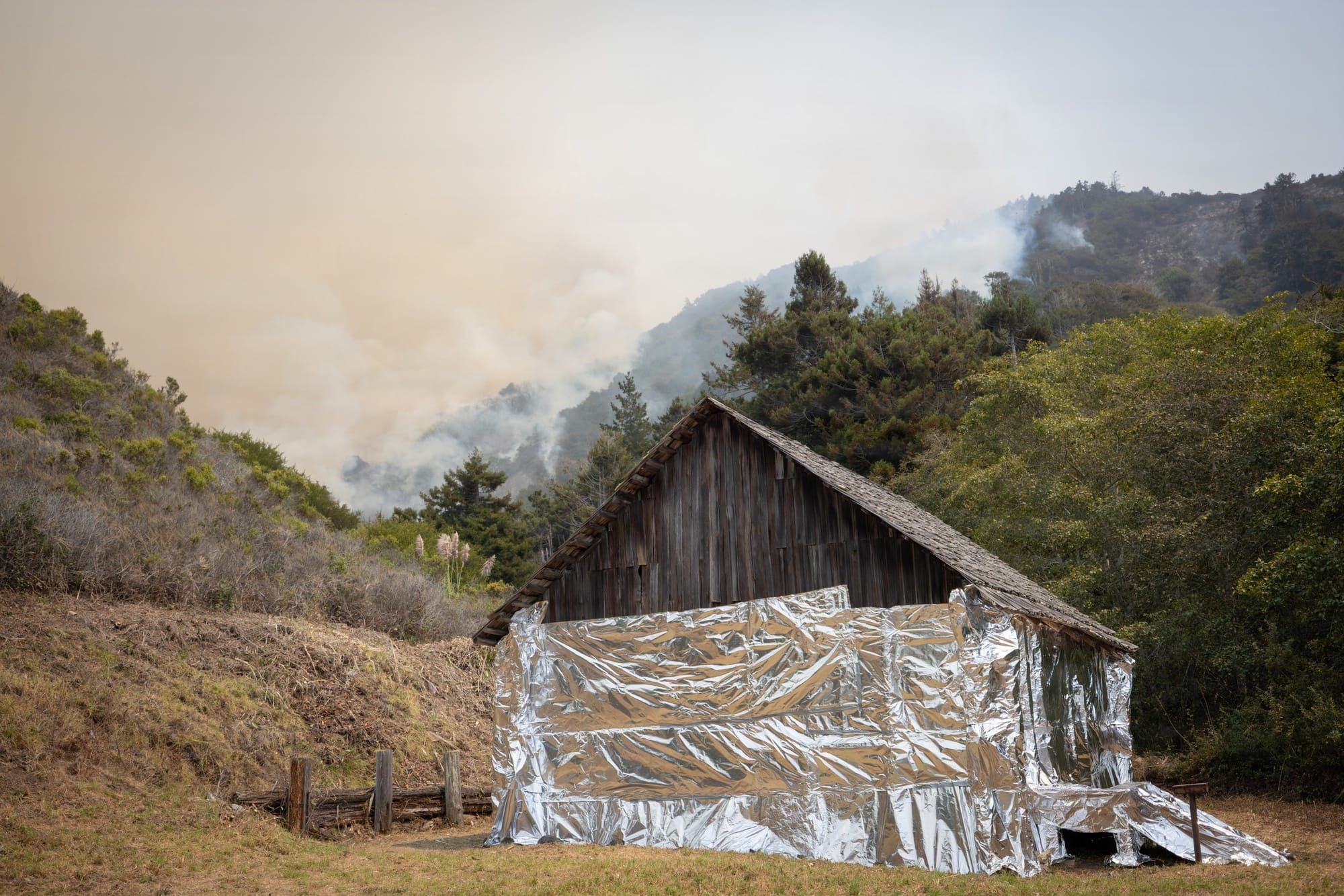
Where wrap has been used in the field is documented: the Forest Service and the National Park Service (NPS) wrapped the General Sherman Tree and historic structures during the 2021 KNP Complex fire, and structure wrap is a national fire cache item (National Fire Equipment System, NFES 0881) with its own federal specification (USFS 5100-624). That is the record we can point to, and it is a strong one without any embellishment.
What this incident settles
One. A direct hit does not have to mean a total loss. A twelve foot branch burned itself out on this roof. The wrap did not stop the heat, because no thin metal layer does. What it did was hold the receptive surface out of contact and starve it of oxygen for as long as it took, and the crew came back to a roof section that needed replacing rather than a slab and a chimney. The commander put that section at roughly 12 by 12 feet. His judgment on the alternative was the whole structure.
Two. The failure mode worth engineering out is the seam. Nothing about panel width would have changed what that branch did to this roof. Width changes the other failure mode, the one the testing actually documents. In the Forest Service evaluation, wind-driven delamination took hold at the seams, and it was attachment and edges that decided how a wrap performed outdoors. Every seam is somewhere wind can get a purchase, somewhere coverage can gap, and somewhere a crew has to make a call under time pressure. A 40 foot wall takes eight panels and seven seams in five foot material. In twenty foot material it takes two panels and one seam. That is the whole argument for wide format, and it is why FireFoil is made in 5, 10, 15 and 20 foot widths.
Where to go from here
Two things in this account are worth carrying into a real deployment. Assume hidden smoldering wherever something large has burned against a wrap, and treat the seams as the part that decides the outcome. Both are reasons the material is made in 5, 10, 15 and 20 foot widths rather than one.
If you are working out what a specific building needs, FireShields, our distributor for property owners, will size it. Enter the footprint and the number of stories, choose base perimeter coverage or a full wrap, and it returns the kit, the seam length, and the price.
If you would rather read the evidence behind the figures this category quotes, start with Where the 96% Figure Comes From.
Size your coverage at fireshields.com/buy
If you are not sure what your own property needs, reach out. We will talk through the exposure, work out which structures deserve coverage first, and build a personalized protection plan around them.
Working on a commercial property, or interested in carrying FireFoil? Call (855) 918-3473, email info@firefoil.com, or get in touch here.
What this series is
Field Notes with Dan is where the things I have seen in twenty years around structure wrap get written down, including the parts that are inconvenient. Some of it is documented and cited. Some of it, like the account above, is one practitioner telling another what happened, and it is labeled that way. Both are useful. Neither is a performance claim.
The next installment compares the four tactical strategies used to protect a structure today, sprinklers, gels, vegetation treatments, and structure wrap, and where each one breaks.
Sources
- Field-incident account: USFS fire commander, as related to the author, approximately 2009. Personal account.
- Bearinger et al. 2021, Frontiers in Mechanical Engineering 7:702181 (heat transfer through thin metal under firebrand piles).
- CAL FIRE Office of the State Fire Marshal, Building in the Wildland (60 to 90 percent estimate).
- Broyles 2014, Structure Protection Materials Evaluation, USFS SDTDC 1251 1811.
- USFS Specification 5100-624 (2025); NFES 0881.
- NPS / USFS documentation of KNP Complex structure and sequoia wrapping, 2021.
Dan Hirning is President of FireFoil and founder of Firezat (2006), supplying aluminized structure wrap to the US Forest Service, Bureau of Land Management (BLM), National Park Service, tribal nations, and fire agencies in Australia. He writes about wildfire mitigation, structure-ignition science, and what actually protects homes when evacuation orders land.