FireFoil™ Wildfire
Structure Wraps
Wrap it. Leave. Come home.
A last-line shield you put up before you evacuate that reflects radiant heat and blocks embers.
Starting at $595 for the base perimeter kit



The problem
Multiple sources of wildfire spread
How embers ignite structures
Watch how flying embers can bypass defensible space and ignite a structure from multiple access points.
1. Flying embers: up to 90% of structure ignitions start here (IBHS). Wind carries them more than a mile ahead of the fire, onto roofs, into gutters, and through vents.
2. Radiant heat: it pre-heats siding, decks, and vegetation toward ignition, sometimes before any flame reaches the structure.
3. Direct flame contact: when the fire front reaches the structure and its most vulnerable surfaces.
FireFoil™ defends against these by blocking embers, reflecting radiant heat, and directly covering your structure's surface.
See the aluminized structure wrap researchThe solution
FireFoil™ is a critical layer of your wildfire defense plan
FireFoil™ adds a physical barrier layer to protect your structure. For best results, FireFoil™ should be used in conjunction with structure hardening, defensible space, and wildfire monitoring.
Stops flying embers cold
Covers the vulnerable points where embers collect and ignite structures.
Reflects the majority of radiant heat
Redirects up to 96% of thermal radiation away from the structure's surfaces.
Deploys before you evacuate
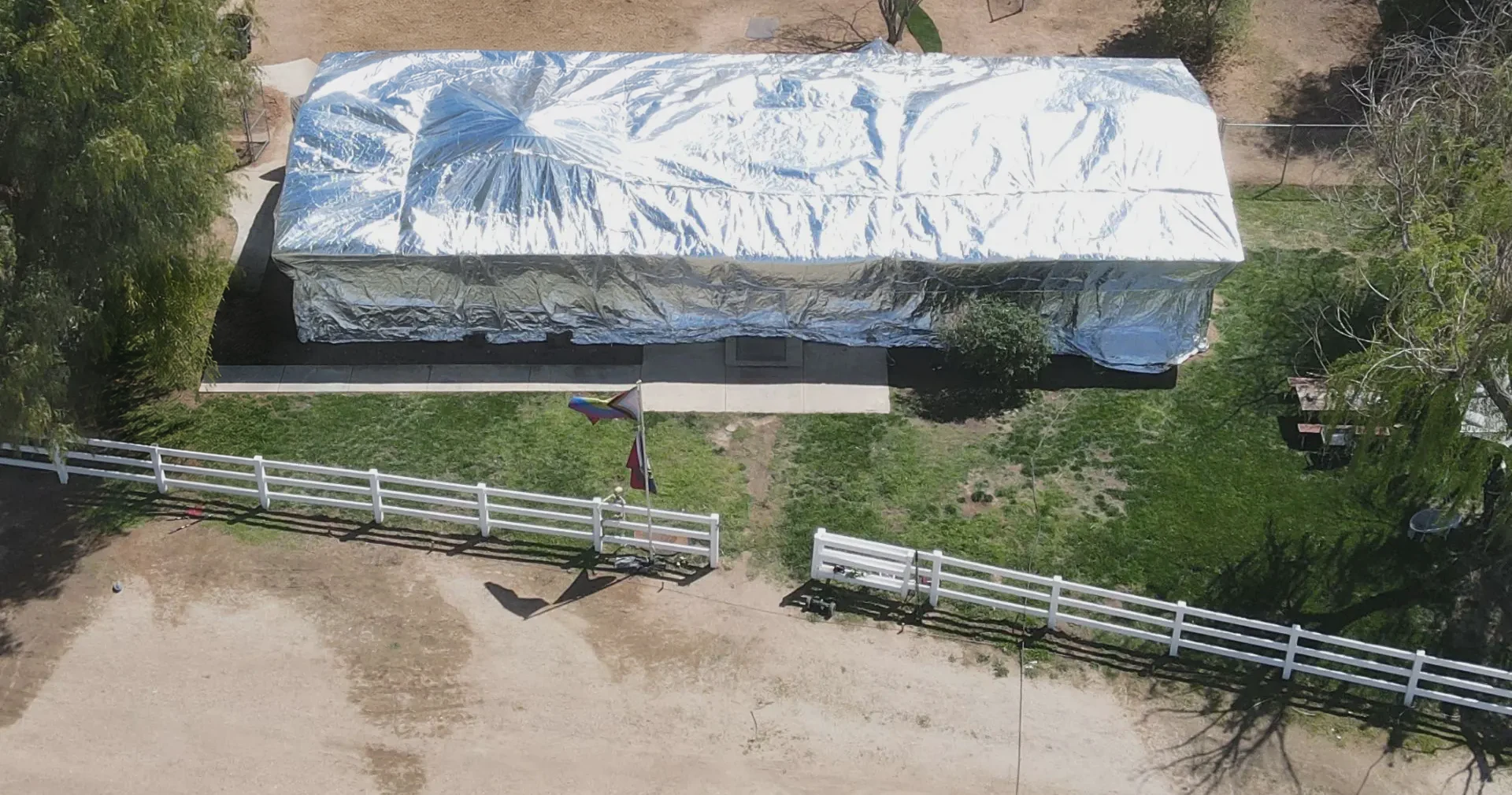
Use as a base-perimeter wrap or tightly wrap the full structure for increased protection.
No water, electricity, or chemicals required
A passive barrier that can be applied regardless of shutoffs and water availability.
How it deploys
Deployment options
For maximum protection, cover the complete structure. Full-perimeter and base-perimeter methods can reduce deployment time and cost, with progressively less coverage.
Complete Structure
Maximum protection
A complete wrap covers the roof and exterior walls for the broadest protection against embers and radiant heat. This is the deployment methodology supported by decades of field use and research. It requires the most material, lead time, and crew.
Full Perimeter
Walls covered, gutters to ground
Extend a 15- or 20-foot panel over the gutters and down to the ground, covering the exterior walls and two common areas for ember accumulation and ignition: beneath the eaves and at the base of the structure. This method is less protective than a complete structure wrap and may leave known risk points exposed, including attic vents, roof surfaces, and roof flashings.
Base Perimeter
Fastest, lowest-cost deployment
Cover the foundation and lower walls to address the largest ember-accumulation threat at the base of the structure. This method offers less protection than a full-perimeter wrap and leaves the eaves, gutters, windows, attic vents, roof surfaces, roof flashings, and other potential ignition areas exposed.
THE DIFFERENCE
One shield, four widths, multiple coverage strategies
FireFoil™ is the only aluminized fire wrap on the market that comes in pre-fabricated widths of 5, 10, 15, and 20 feet. Wider panels cover more wall height per pass, which means fewer seams and fewer joins for a crew to secure, which is what makes larger deployments practical. Narrower rolls cover the base fast, where structures ignite first.
Best for: Base-perimeter wraps, decks, fences, and tight areas.
Best for: Walls, garage doors, and mid-size surfaces.
Best for: Wrap from gutters to the ground.
Best for: Roofs and full walls for the fewest seams.
How it anchors to a structure
FireFoil™ is anchored to the structure with staples, strapping, or wire mesh, depending on construction. Deploy before the fire front arrives, and never delay evacuation. Reusable when undamaged and stored properly.
Size Your Coverage Needs
How Much FireFoil™ Does Your Structure Need?
Answer a few questions in the FireShields calculator and get a coverage plan sized to your structure.
Sold through our authorized store, FireShields.
THE PROOF
Why FireFoil™ is the standard
FireFoil™'s aluminized structure-wrap technology has been used by wildland firefighters, the US Forest Service, and private property owners for decades.
FireFoil™ helped this cabin stay standing while 65 around it burned
“I felt helpless — and a sense of peace at the same time — having the FireFoil™ on.”
Craig Way and Alison Loar, property owners, Colorado
Structure wrap in action: cabin protected from wildfire
A controlled burn test showing how aluminized structure wrap reflects radiant heat and blocks direct flame contact on a full cabin.
Read the Aluminized Structure Wrap ResearchAs seen in






For insurers and government agencies
Carriers, MGAs, and public agencies source FireFoil™ through dedicated partners.
Insurance & MGAs

Insurance carriers and MGAs use Wildfire Arsenal to deploy FireFoil™ at scale and protect insured properties from wildfire loss.
Government agencies

Federal, state, and local agencies source FireFoil™ through Firezat for fire-line operations and critical asset protection.
Learn more about our authorized FireFoil™ distributors.
Stay informed
Join Our Mailing List
Stay in touch with fire season alerts and product updates.