The strongest wildfire strategy is a layered defense, but the real measure of each strategy is not only its effectiveness, but also its potential failure points under severe fire conditions. These include high winds, single-digit humidity, and extreme heat, especially since they must perform perfectly with no human intervention.
Under those severe conditions, evacuations may occur days before ember or fire arrival, while electricity, water pressure, and available structure-protection resources may be lost or stretched beyond capacity.
Fast fires vs. notice fires
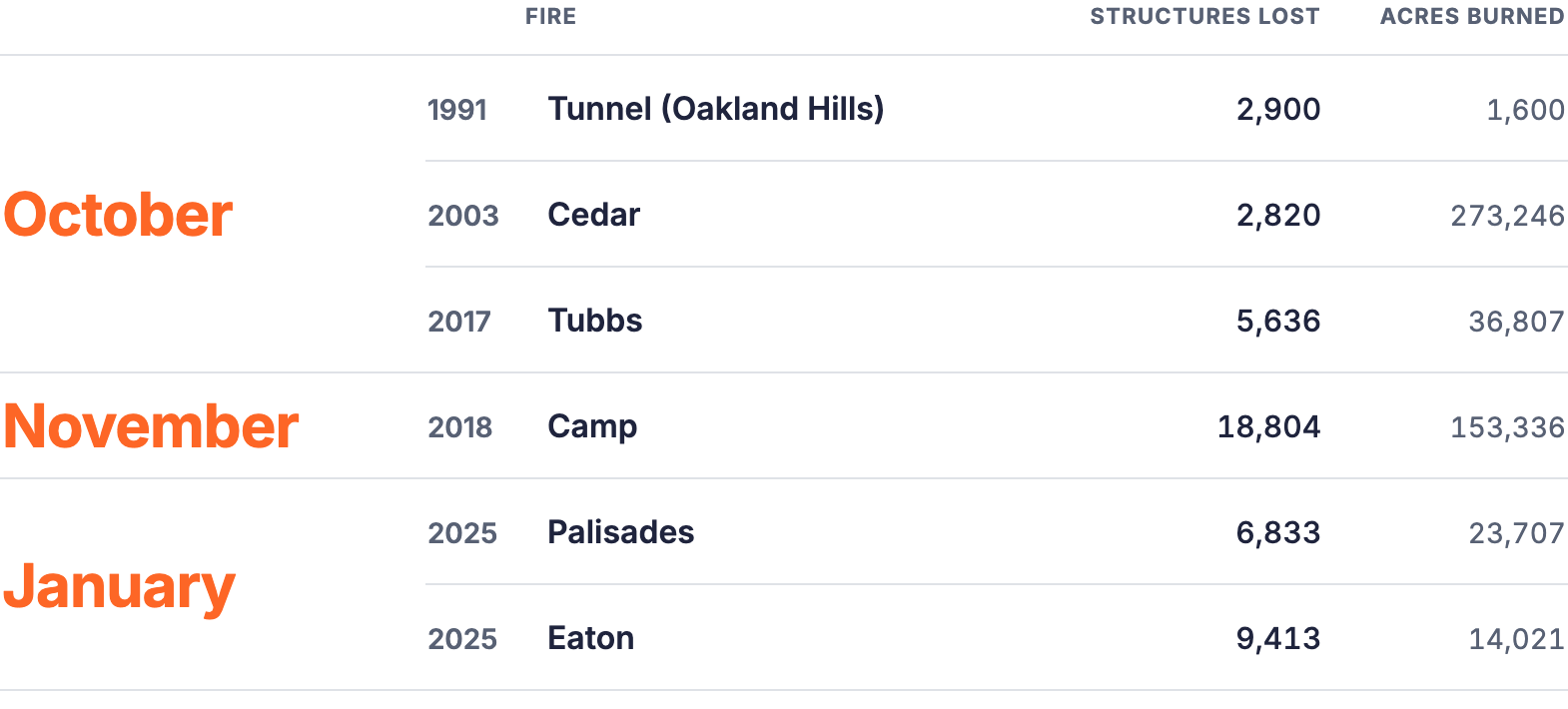
In a fast fire, such as the Palisades and Camp fires, there is little or no safe property-protection window after ignition. High winds accelerate the fire front, embers attack across neighborhoods, compromise roads, and convert individual structure ignitions into a community conflagration, or structure-to-structure spread. Once evacuation routes are threatened, life safety and triage take priority.
Defensible space and home hardening are the most important steps for homes in high-risk Wildland-Urban Interface (WUI) areas. Firewise USA organizes the community, while the Insurance Institute for Business and Home Safety (IBHS) Wildfire Prepared provides practical guidelines for protecting the home. Both provide valuable insights and direction.
A notice fire is a wildfire whose predictable rate of spread gives firefighters and residents adequate advance warning, often hours or days, to evacuate, stage resources, and protect structures before the flames arrive.
The four tactical strategies
Here are the most used wildfire mitigation strategies to save homes. Having a layered defense is always best. Each layer protects the last link in the Combustion Chain, the home itself: preventing the structure from becoming fuel, consuming itself, producing embers, starting spot fires, and igniting neighboring homes.
- Perimeter and Exterior Wetting Systems (Sprinklers)
- Fire-Retardant Gels and Foams
- Vegetation and Fuel Reduction Treatments
- Active Shielding (Aluminum Structure Wrap)
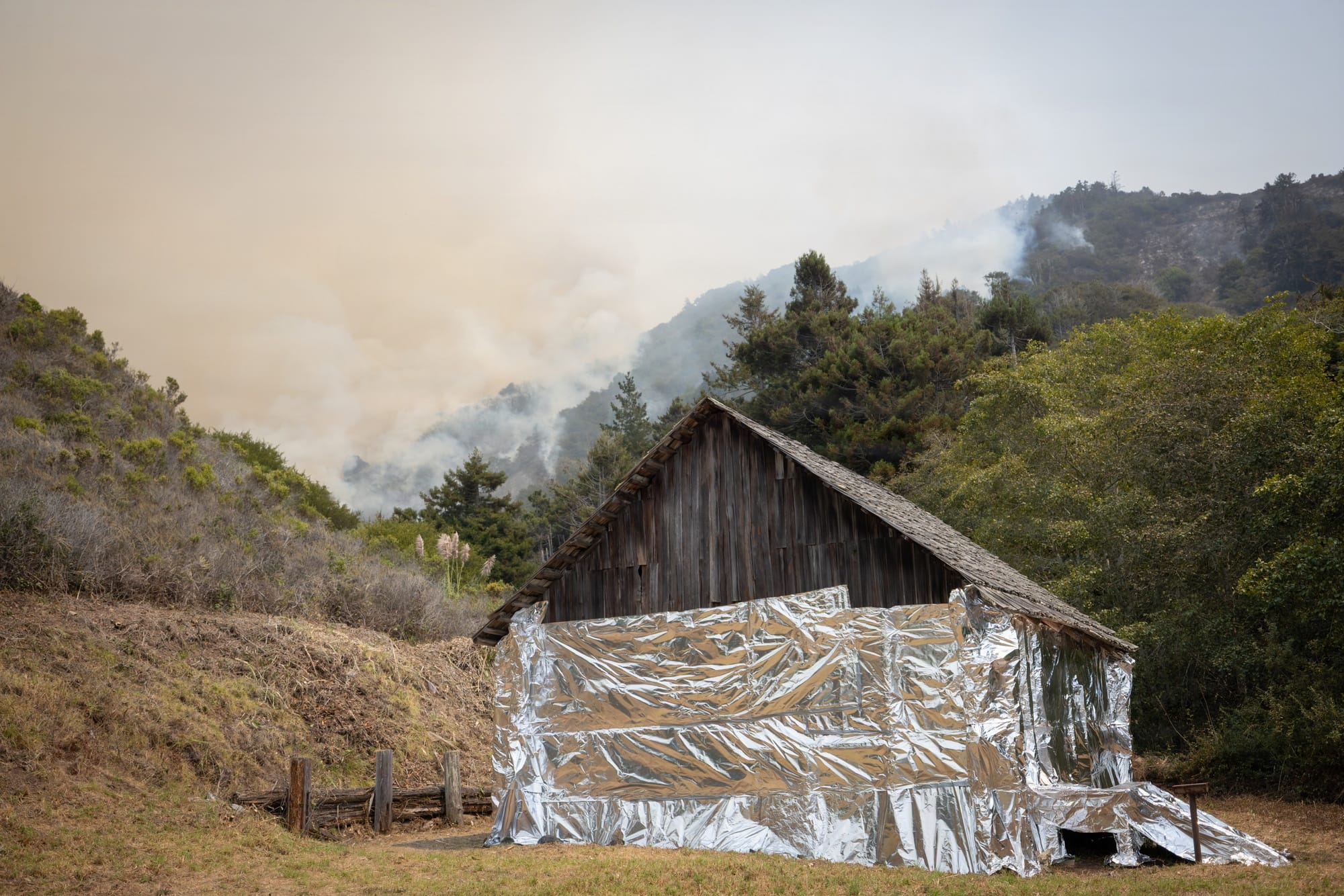
One of them, aluminum structure wrap, has been used for decades by the professionals tasked with protecting our national historical treasures and critical infrastructure.
| Needs water / power | Needs attendance during the fire | Holds if the fire arrives days late | Reusable | Key failure modes | |
|---|---|---|---|---|---|
| Sprinklers | Yes, both | Yes, ideally | Only while supply lasts | Yes | Power or pump loss, wind-driven overspray, empty tanks |
| Gels and foams | Yes, water and pressure | Application window is critical | No, dries out in hours | No | Applied too early, uneven coverage, drying |
| Vegetation treatments | Water for application | No | Days to weeks, weather permitting | No | Rain, wind, regrowth, incomplete coverage, embers overfly |
| Structure wrap | No | No, once installed | Yes, until removed | Yes, if undamaged | Seams, wind lift on edges, partial wraps, direct flame contact |
Tactical intervention can make a difference
Major wildfires can stay active for days or weeks before full containment, which creates a real operational window for tactical mitigation after the fast start. For homes downwind or in the projected path, early action can shift outcomes from total loss to survivable damage. Even when conditions are chaotic, basic mitigation steps, taken quickly and correctly, can reduce structure loss.
For insurance and fire professionals, the operational reality is that wildfire losses are often determined before ignition, while preventable vulnerabilities remain unaddressed in the hours or days leading up to fire arrival. A structured tactical approach that enables homeowners to act early, with proven methods, can reduce structure-to-structure ignition, lower severity, and increase the likelihood that a home remains standing with minimal to no damage.
These tactical mitigation strategies can all be effective in the right circumstances, but they require a full review of effectiveness, potential failure points, the threat profile, and available resources. Many mitigation methods require ongoing human support after setup, which may be unavailable once mandatory evacuations begin.
1) Perimeter and Exterior Wetting Systems (Sprinklers)
Where it helps: Reduces spot ignitions caused by embers on receptive fuels and helps keep some exterior surfaces cooler when the water supply is reliable.
Requires: Abundant or adequate water source and pressure. Lake, river, deep well, large pool, or gravity storage tanks. Independent electrical generation, fueling, and a person to troubleshoot if safe to stay.
Limits: Water can be unavailable during events such as power outages, pump failures, or damaged lines, and wind can reduce effective coverage. Excessive water can damage the structure if it enters through vents or cracks.
Best use: When attended during a fire event. A supplement to hardening and fuel management, not a standalone solution.
Potential failure points: Loss of power or pump priming; generator refueling; inadequate water volume or pressure; clogged inlets and spray nozzles or filters; wind-driven overspray leaving dry zones; poor zone coverage at eaves, corners, and attachments; empty tanks or restricted water supply; system activated too early or not in time; burning debris melting feed lines; rapid evaporation in high winds and single-digit relative humidity. Sprinklers are recognized by IBHS as a secondary mitigation tool but not as a primary protection method in most cases.
2) Fire-Retardant Gels and Foams
Where it helps: Short-duration surface protection when applied correctly and close to the ember and fire threat arrival.
Requires: Strong water pressure, long hoses to reach all parts of the property, an ample water supply, a generator and pump, a gel or foam product, and last-minute access to the property for multiple hours as close to ember arrival as possible.
Limits: Application can be messy, requires professional equipment and time for proper coverage, and effectiveness varies with thickness, relative humidity, temperature, winds, evaporation, and time to fire or ember arrival. Not reusable.
Best use: Targeted augmentation on vulnerable features, not an all-property dependency.
Potential failure points: Applied too early or too late to finish; uneven or incomplete coverage; drying, wind, or water reducing effectiveness; limited access to roofs and ember-entry points; material staining or cleanup issues. IBHS found water-enhancing gels reached 50 percent dehydration in under 1.5 hours and full dehydration in about 7 hours under severe drying conditions, with protection declining as they dried.
3) Vegetation and Fuel Reduction Treatments
Where it helps: Temporarily reduces the ignitability and fire spread of treated vegetation near structures.
Requires: Appropriate spray equipment, water, complete coverage, and application according to the product manufacturer's specified pressure, mixture, and coverage rate.
Limits: Effectiveness can last days or weeks in dry conditions but may be reduced by rain, irrigation, wind, abrasion, incomplete coverage, or vegetation growth. Reapplication may be required. Not reusable.
Best use: Supplemental treatment for selected vegetation and high-exposure areas, combined with defensible space and home hardening.
Potential failure points: Incomplete or uneven coverage; untreated vegetation across property lines; application too early or too late; rain, irrigation, wind, or weathering reducing effectiveness; regrowth after treatment; inaccessible trees or dense fuels; embers traveling over treated areas to ignite the structure.
4) Active Shielding (Aluminum Structure Wrap)
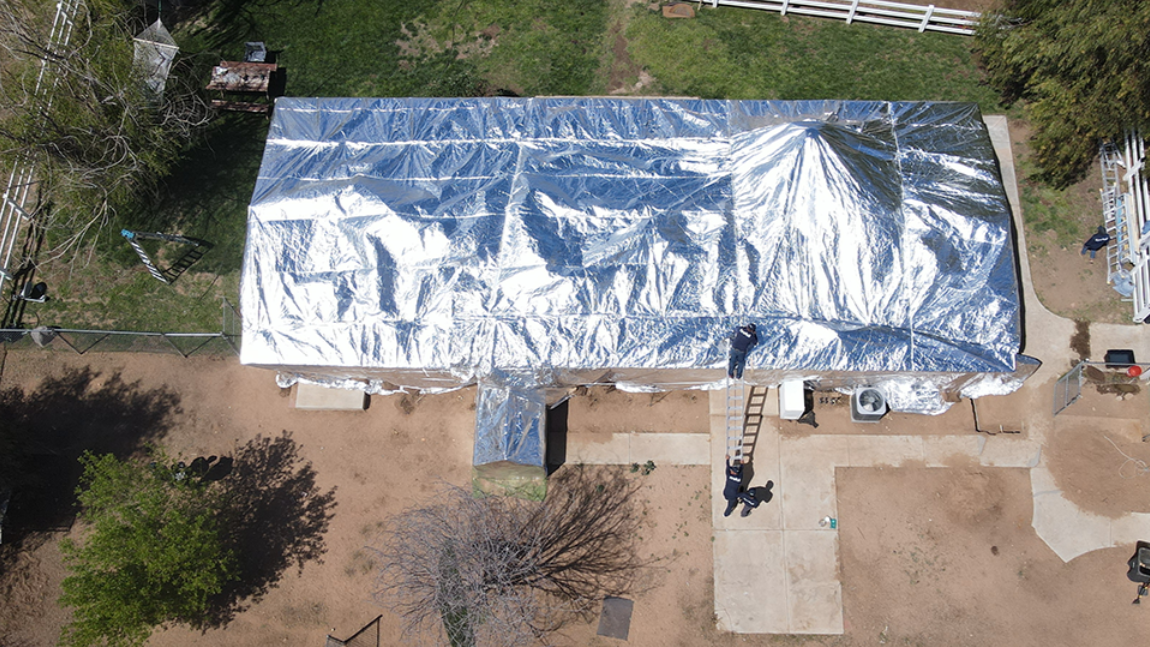
Where it helps: Used by the Forest Service to protect historic and high-value structures, aluminized wrap is a passive barrier against embers and radiant heat. It covers the ignition points embers exploit: vents in the foundation and attic, windows, eaves, gutters, and the leaves, pine needles, and debris that collect at them. It requires no water or electricity and uses no chemicals. Once installed, it requires no further attendance while deployed.
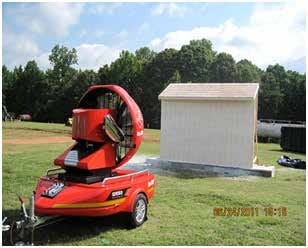
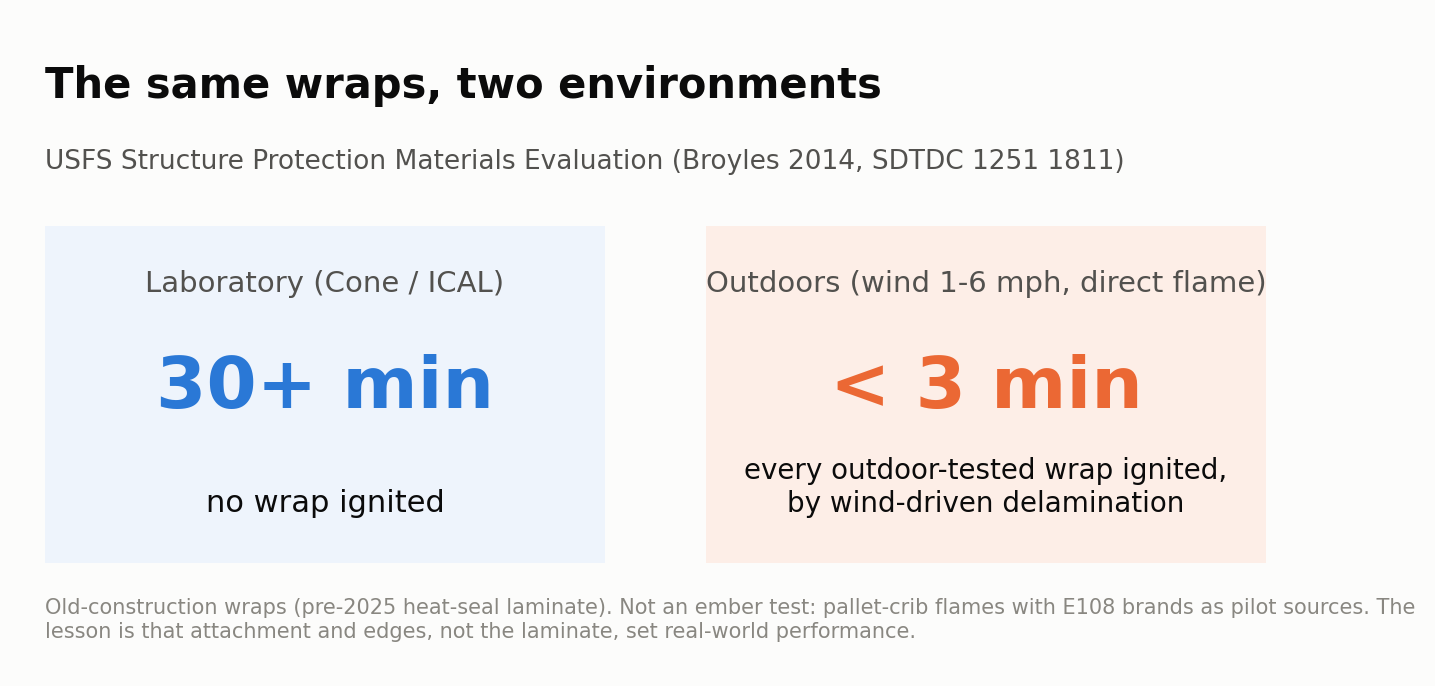
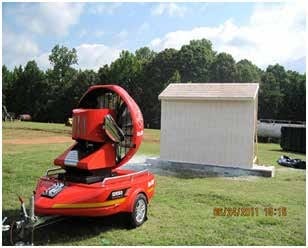
Limits, honestly stated: Installation takes time and planning. Wind is the enemy of any membrane: anchoring matters, and edges, seams, and partial wraps are where failures start. In the only public head-to-head test program, USFS testing (Broyles 2014), wrap materials that survived 30 or more minutes of radiant exposure in the lab failed in under 3 minutes of direct flame contact outdoors, and some older-construction products delaminated. Radiant heat and embers are the design case for wrap; direct, sustained flame contact from fuels against the structure is not. That is why defensible space still comes first. There is also, today, no listing category or certification scheme anywhere for deployable structure protection: no Underwriters Laboratories (UL) category, no International Code Council Evaluation Service (ICC-ES) pathway, no Office of the State Fire Marshal Building Materials Listing category. Standards work has finally started, an ASTM International (ASTM) subcommittee, E05.14, and a Consumer Product Safety Commission (CPSC) working group, both opened in 2025, and we support it.
Best use: Protecting high-value structures from ember attack and radiant heat when the arrival time is uncertain, which it almost always is. Because wrap needs no water, power, or attendance, it is the layer that is still working days after evacuation.
Why firefighting agencies use aluminum structure wrap for high-value and critical assets
Ember and fire arrival are never known, and evacuations eliminate human intervention once ordered. The National Institute of Standards and Technology (NIST)'s hazard mitigation methodology, Technical Note 2205, is blunt about what ember protection requires. In NIST's words: "If very high ember exposures impact the structure, it is improbable that the structure will survive unless all the ember hardening identified in Table A had been implemented." Complete coverage is the requirement, and a wrap is the one tactical layer built to be complete.
Aluminum structure wrap has been used for decades to protect high-value, high-consequence structures because once deployed, crews can leave knowing the structure remains protected until the wrap is removed, for days or weeks, allowing them to focus on other structure protection priorities. Deploying wrap allows homeowners to Wrap-n-Leave with confidence.
Where to go from here
Pick your layers by what they still need from you after you leave. Defensible space and home hardening come first, and they hold on their own. Sprinklers and gels can carry real weight when someone is there to run them and the water holds. Wrap is the layer that keeps working unattended, which is why the agencies responsible for irreplaceable structures reach for it when arrival time is unknown.
If wrap is the layer you want to add, size it while nothing is happening. FireShields sells FireFoil direct and sizes it for you: enter the footprint, the number of stories, and whether you want the roof covered, and you get the recommended kit, the total seam length, and the price. Stocked sizes ship in one to two business days. Widths over five feet are fabricated to order, so lead time matters more than most people expect.
Size your coverage at fireshields.com/buy
If you are weighing the trade-offs above against your own property, reach out. We will walk the exposure with you, work out which structures deserve coverage first, and build a personalized protection plan around them. Working on a commercial property or a portfolio, or interested in carrying FireFoil? Contact us.
Sources
- NIST Technical Note 2205 (2022), WUI Structure/Parcel/Community Fire Hazard Mitigation Methodology (quoted verbatim).
- National Fire Protection Association (NFPA) Firewise USA.
- IBHS Wildfire Prepared Home Technical Standard.
- The California Department of Forestry and Fire Protection (CAL FIRE), Defensible Space.
- IBHS, External Sprinklers for Wildfire Defense.
- IBHS, Fire-Retardant Gels: Weathering and Performance.
- Broyles 2014, Structure Protection Materials Evaluation, USFS SDTDC 1251 1811.
- USFS specification 5100-624; NFES 0881 (national fire cache item).
Dan Hirning is President of FireFoil and founder of Firezat (2006), supplying aluminized structure wrap to the US Forest Service, Bureau of Land Management (BLM), National Park Service, tribal nations, and fire agencies in Australia. He writes about wildfire mitigation, structure-ignition science, and what actually protects homes when evacuation orders land.